Home  /  OEM/ODM
OEM/ODM Delivery

Standard-model OEM or ODM customization, with clear scope and accountable owners.

SmartXY supports established brands, strong channel partners and funded enterprise teams. Select a current standard model for OEM branding and packaging, or scope an ODM customization project. Align the purchasing or development budget, order plan and responsibilities with the chosen route.

Models
OEM · ODM · JDMStandard model + branding → customization → joint engineering
Governance
IPD + AgileEVT · DVT · PVT · MP gates
Investment
Scoped proposalNRE · tooling · licensing · production
Commitment
Phase gatesDeliverables · owners · acceptance

GLOBAL AI EYEWEAR DEVELOPMENT PARTNER

From your product brief to a production programme.

Explore three eyewear platforms, the engineering and reliability workflow, four SDK integration layers and the Premium ODM Development Program for highly customized products.

Explore Custom AI Eyewear Development

Standard-platform OEM purchasing and existing SDK policies retain their own project scope.

Engagement Model

OEM, ODM and JDM, with a technology-transfer option.

Choose standard-model OEM for an agreed product with your branding, or ODM for a defined customization project. JDM and technology transfer add deeper engineering or capability handover when the business requires it.

OEM

Standard model, your brand

Select a current SmartXY model and agree your logo, packaging, product configuration and purchase plan. Any requested software or hardware changes are reviewed separately.

  • Best for: established brands and channels with a funded procurement plan
  • Focus: branding, agreed configuration, quality and delivery reliability
  • IP: rights and permitted use documented in the agreement
  • Quantity: pilot and production volumes agreed per project
ODM

ODM product customization

Start from an agreed SmartXY platform, then scope POC, PRD, ID/CMF, CNC Function Prototype, UI, firmware protocol/app, regional certification, and packaging.

  • Best for: the best fit to the local market
  • Focus: platform reuse with light customization
  • IP: platform, brand and custom deliverables scheduled separately
  • Commercial: NRE + Tooling Mold + Production
JDM

Custom Engineering

Co-engineer a differentiated product on a SmartXY base platform — hardware options, chips, optics, firmware/app scope and regional compliance defined per project.

  • Best for: differentiated, category-defining launches
  • Focus: deep, controlled customization
  • IP: source access, ownership and licensing agreed by asset
Optional Technology Transfer

Build local capability

For qualified partners investing in an engineering team or local manufacturing. Scope authorized source, design, process and test documentation with training and staged acceptance.

  • Best for: funded platform owners and localization projects
  • Commercial: assessment, licensing, training and transfer quoted by scope
  • Rights: subject to asset ownership, third-party permissions and agreement
Explore technology transfer →

Build-to-print OEM is a separate scope

When the customer controls the design, begin with authorized drawings, BOM, revision history, manufacturing rights and acceptance requirements. Review manufacturability, supply responsibility, test fixtures and change control before agreeing a build-to-print scope. A standard-platform branding request does not automatically include customer-design manufacturing, engineering changes or source rights.

Samples & commercial scope

Separate evaluation costs from development and production.

A sample evaluates a named hardware, firmware and software configuration against your workflow. It does not establish production readiness or include every interface, source right or customization.

1. Select and scope

Choose the platform and required task. Confirm sample availability, build versions, included SDK/App, accessories and known limitations. For a current standard configuration, a business owner can lead the request; engineering ownership is needed for changes.

2. Agree the evaluation

Record the sample quantity, separate hardware and software charges, delivery contents, support scope and test plan before ordering. Confirm any loan, return or replacement terms in the quotation; no common policy is assumed.

3. Review evidence

Record test conditions, results and open issues. Both teams decide whether to use the standard configuration, commission defined engineering work or stop the evaluation. Pilot and production commitments require their own agreement.

Quotation checklist — categories are included only when applicable; no prices or minimum order are implied.
Cost categoryConfirm in the proposalResponsibility to agree
Hardware samplesBuild, quantity, accessories, included tests and sample termsBuyer approves the evaluation configuration; supplier identifies what ships.
Engineering / NRESpecific hardware, firmware, SDK or App changes, milestones and acceptanceNamed technical owners approve the statement of work and change requests.
Molds, tooling and fixturesDesign, ownership, maintenance, validation and any reuse limitsAgree funding, custody and release conditions by item.
Certification and testingModel, version, market, test scope and retest assumptionsConfirm applicant, laboratory coordination and who funds changes.
Third-party licensesComponent, SDK, codec or service rights and recurring chargesIdentify license holder, permitted use and renewal owner.
App and cloud servicesApp delivery, accounts, model/API usage, hosting, updates and supportCustomer-operated services and separately commissioned supplier work are listed distinctly.
Production unitsApproved configuration, order volume, packaging, inspection and spare partsAgree order acceptance, quality release and after-sales responsibilities.
Logistics and taxesShipping basis, insurance, import duties, taxes and local handlingConfirm importer, carrier arrangement and payer in the commercial terms.

The C100 standard Android SDK policy remains separate from sample hardware and paid SDK modifications. Any published minimum development fee applies only to its named service and scope, not every SDK request or hardware purchase. A previous customer budget is not a universal fee schedule.

Request C100 standard SDK · Evaluate a K900 sample · Discuss AR99 branding · Scope custom development

Customer ODM experience

Give your next product a head start.

SmartXY has undertaken customer ODM projects using K900 and EG01 as starting platforms. This experience can help your team reduce repeated exploration, trial and error, and the hidden costs of bringing a new smart-glasses product to life.

K900 · Customer ODM

BCI integration

K900-based brain–computer interface (BCI) integration for a customer ODM project.

EG01 · Customer ODM

Audio glasses for hearing accessibility

EG01-based audio glasses developed through ODM for people with hearing loss.

K900 · Customer ODM

Temperature, blood oxygen and heart rate

K900-based ODM work adding a temperature sensor alongside blood-oxygen and heart-rate monitoring.

Build on prior integration experience to identify requirements earlier and focus engineering effort on what is specific to your product. The aim is less repeated work and a clearer development plan.

Customer project features are scoped separately from standard platform specifications. Reuse, software rights, validation, NRE and timelines are agreed for each new project.

Discuss your ODM project
Project guides

Explore platform and channel project guides.

Find the project-fit notes and RFQ requirements for your product category, branding model or target channel.

To compare practical changes, responsibilities and delivery boundaries, read Vanda’s personal OEM, ODM and JDM guide.

Capability Ladder

ODM/JDM development, from definition to MP.

Apply the development stages below to the agreed customization scope. Standard-model OEM follows its branding, configuration, validation and order plan without requiring a new product-development project.

01

Requirement freeze

Market scope, specs, ID/CMF, certification, budget and launch schedule.

02

Architecture

Chipset, OS, power, camera/audio, optics, SDK/API and OTA plan.

03

ID / MD / HW / SW

ID, mechanics, electronics, firmware, app and algorithm interfaces.

04

Prototype

CNC, 3D print, PCB/FPC samples, dev boards and interaction validation.

05

EVT / DVT

Functional, DFM, optical, electronic, acoustic, thermal and reliability validation.

06

PVT

Trial build, process validation, yield metrics, reliability reports and certification.

07

MP release

Yield ramp, agreed traceability records, QC plan, packaging, logistics and lifecycle responsibilities.

Decisions and evidence

Move to the next stage when the agreed evidence is ready.

The development activities above need explicit decisions, identified builds and an acceptance owner. This is a planning framework, not a statement that a platform has passed every gate. Standard-platform procurement follows the agreed configuration and order plan; it does not require a new development programme from the beginning.

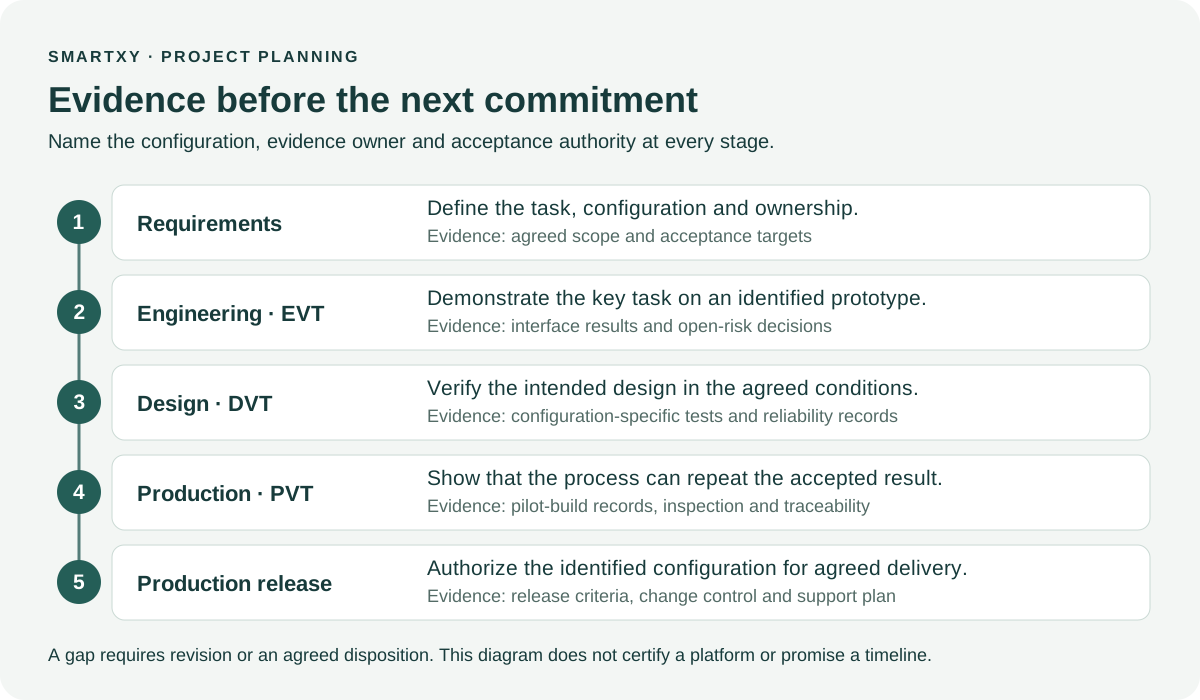
Five project decisions: requirements, engineering validation, design validation, production validation and production release. Each needs evidence and an agreed acceptance decision.
SmartXY planning diagram. The table below states the decisions and evidence in full. A gap can lead to revision or another evaluation; elapsed time alone does not close a gate.
Set configuration-specific acceptance criteria before reviewing a stage
StageDecisionEvidence to agreeCondition for the next stage
RequirementsWhat exactly are we building?User task, configuration, owners and acceptance targetsBoth teams agree scope, responsibilities and the evaluation plan.
Engineering validation (EVT)Does the chosen architecture perform the key task?Identified prototype, interface results and unresolved risksThe key task is demonstrated on the named build; open risks have owners and an agreed disposition.
Design validation (DVT)Does the intended design meet the agreed conditions?Configuration-specific test and reliability evidenceThe intended design meets the agreed criteria or documented exceptions are accepted by the responsible authority.
Production validation (PVT)Can the process repeat the accepted result?Pilot-build records, inspection methods and traceabilityThe agreed production process and inspection evidence support the planned build.
Production releaseIs this configuration ready for agreed delivery?Release criteria, change control and support arrangementsThe designated acceptance owners authorize the identified configuration and delivery scope.

Record the result, open issues, evidence location and acceptance owner in the blank delivery checklist. Timing, test limits and commercial commitments are agreed per project. Use the ODM manufacturing guide to prepare your brief.

Blank planning template · No project results

EVT / DVT / PVT delivery and acceptance checklist

Copy this blank checklist for the agreed phase. Every item starts unfilled; it is not a completed quality record, a certification or evidence of customer acceptance. Scope, owners and acceptance limits must be agreed before a gate review.

Project / platform: ______   Stage (EVT / DVT / PVT): ______   Review date: ______
Hardware / firmware / SDK / App versions: ______
Supplier owner / customer owner / acceptance authority: ______

Fill the artifact reference, responsible owner, revision, due date and acceptance criterion for each required item.
DeliverableArtifact / revisionOwner / due dateAcceptance condition
Version baseline, drawings / CAD and BOMTo fill: ______To fill: ______To agree: ______
Change log and implementation evidenceTo fill: ______To fill: ______To agree: ______
Test plan, conditions and result summaryTo fill: ______To fill: ______To agree: ______
Defect list, closure evidence and open exceptionsTo fill: ______To fill: ______To agree: ______
Gate decision and customer acceptance recordTo fill: ______To fill: ______To agree: ______
Packaging, labels, accessories and shipping configurationTo fill: ______To fill: ______To agree: ______

Record four independent states per item

  • Received: ______   Evidence / date: ______
  • Implemented: ______   Build / change evidence: ______
  • Tested (pass / fail / pending): ______   Test report: ______
  • Customer accepted: ______   Authorized sign-off / date: ______

Record pending, complete or not applicable with evidence and an owner; record test outcomes explicitly. Receiving CAD does not show implementation; implementation does not show a passed test; a passed test does not show customer acceptance.

Close the phase with explicit evidence

EVT: agree functional and interface evidence on the named prototype. DVT: agree design and reliability evidence for the intended conditions. PVT: agree process, inspection and shipment-configuration evidence on the pilot build.

For every phase, fill measurable pass criteria, open defects, approved exceptions and next-step owners. Only the authorized customer representative can complete the customer-acceptance state. This public template contains no customer files or test results.

Reference architecture · Project-scoped

Scope capture hardware and calibration as an ODM project.

For Embodied AI Data Capture Glasses, the XY-DC Reference Architecture defines a display-free ODM evaluation direction. Begin with the dataset workflow and engineering acceptance criteria, then agree feasibility, prototypes and validation milestones. Tooling, calibration-station design and production-line integration are scoped per project.

01Multi-camera hardware synchronization

Evaluate rigidly mounted forward stereo cameras, sensor-level trigger alignment and the ISP/MIPI integration path. Define how frame timestamps and inertial samples relate to the capture clock. Document the sensor and host interfaces, then measure synchronization error and timestamp behavior on the agreed prototype.

02Per-unit factory calibration

Define intrinsics, extrinsics, distortion and rectification outputs, serial-number association and machine-readable delivery. Scope the calibration station, tooling and line integration as project work. Agree calibration procedures, output formats, acceptance criteria and repeatability checks before committing production delivery.

03Cross-device wireless synchronization

Evaluate wrist, body-worn or tool-mounted companion capture modules as separate development items. Define the relationship between head-unit and companion clocks, reconnection behavior and cumulative drift. Measure alignment and drift across the intended recording duration and wireless conditions; no synchronization accuracy is published.

04Continuous-record power and thermal architecture

Model concurrent camera capture, encoding, storage and periodic upload against the requested working-shift duty cycle. Review battery architecture, heat paths, fit and the resulting weight budget together. Validate recording duration and thermal behavior under the agreed workload and environment before confirming device specifications.

05Verifiable privacy controls

Evaluate an externally visible mechanical camera shutter and a mechanical microphone mute. Define how each control changes capture state and how the wearer and people nearby can verify that state. Review the physical controls and capture-state behavior alongside the project owner's consent, retention and intended-use requirements; hardware alone does not establish deployment compliance.

06Capture-point provenance

Evaluate secure-element signing at capture, key ownership, controlled provisioning and verification by the receiving system. Include relevant cryptographic and intended-use review in project definition. Agree the threat model and recording-integrity checks, then validate the signing and verification path on the selected hardware and software.

The XY-DC Reference Architecture is separate from existing camera and display products. Component selection, sample scope, quantities, commercial terms, development schedule and acceptance evidence are agreed per project. No fixed runtime, calibration accuracy or standard secure-element capability is published.

IPD + Agile

Stage-gate rigor with fast weekly execution.

SmartXY uses an IPD-inspired lifecycle adapted for lightweight, high-speed smart-eyewear projects. Each phase has entry/exit criteria — when criteria are not met, the project does not move forward blindly.

Project initiationFeasibility studyPlanningDevelopmentVerificationLifecycle management

Phase gates that protect time, cost and quality.

01

Concept & planning

Cross-domain co-initiation across acoustics, optics, electronics, software, hardware, structure and supply chain.

02

Development

High-frequency prototype iteration with DFM embedded before design lock.

03

Verification

EVT, DVT and PVT gates establish KCP controls to pre-identify and mitigate risks.

04

Mass production

Trial-production review, yield ramp-up, test-tooling finalization and MP execution.

Customer Co-Development

Not only a supplier — a technology partner with transparent decision-making.

For strategic projects, the most important deliverable is a traceable decision system that lets both teams see risks early and close issues fast.

End-to-end process sync

Requirement intake, solution design, key-device selection, development and testing validation are fully visible.

Joint solution review

Customer participation in architecture, interface definition, BOM decisions and optical/HW/SW routing.

System alignment

Drawings, documentation templates, code specs, material control, version management and test standards.

Dedicated interface owners

A dedicated PM and technical lead per project to reduce cross-department communication overhead.

Delivery objectives

Progress visibility, risk controllability, clear accountability and traceable milestones.

One traceable system

Decisions, risks and versions visible end-to-end — the core of low-risk co-development.

Communication Cadence

High-frequency, transparent and closed-loop control.

Hybrid development model combining IPD rigor with Agile responsiveness.
Weekly synchronization on progress, risks, shared understanding and action plans.
Cross-functional reviews across mechanical, hardware, software, optics and supply chain.
Transparent reports: progress, risk register, version history, issue and prototype status.
Dedicated project taskforce with centralized allocation of high-priority resources.
Support coverage, severity definitions, escalation owners and response targets agreed in the statement of work.
Software Co-Development

Progress, bug and version control aligned with customer systems.

Daily development plans, weekly project sync, technical review, monthly retrospective, code review, release review and version change logs with impact scope, timing and rollback strategy.

Requirements reviewDesign reviewCode walkthroughTest reportsRelease reviewAPI co-creationComponent library managementVersion naming conventions
IP & Data Protection

Clear IP boundaries, code isolation, delivery encryption and privacy-by-design.

01Standardized R&D process

Requirements → proposal → design → test → MP review with full-process documentation and version control.

02Legal safeguards

NDA, software copyright and IP-ownership agreements define cooperation boundaries before deep development.

03Access control

Role-based access control, permission hierarchy and immediate revocation upon personnel departure.

04Code isolation

Dedicated code repository per client project with strict isolation from other projects.

05Environment isolation

Independent development, testing and delivery/release environments.

06Delivery protection

Agree the delivery format for each component: documented API, binary, authorized source or a continuity arrangement. Third-party rights and signing-key ownership remain explicit.

07Audit & traceability

Logging of code access, download, commit and artifact transfer for a complete audit trail.

08Privacy architecture

Define data minimization, least-privilege access and the processing location for sensitive data according to the selected platform and application.

Project-scoped traceability

Agree manufacturing records before production.

Supply chain mgmt

Define cost, order, procurement, inventory and quality records required for the agreed project.

Production mgmt

Agree the BOM revision, material records, inspection evidence, warehousing records and reporting owners.

Unit and lot records

Define serial or lot identifiers, required process parameters and error-proofing evidence; confirm implementation on the selected line.

ERP / MES requirements

If system integration is required, agree the data fields, access, owner and validation. Availability and deployment status need project-specific confirmation.

Typical Timeline

A schedule built around your agreed scope and validation gates

Timeline depends on optical complexity, certification scope, tooling, firmware/app/cloud integration and requirement-change discipline. The earlier requirements are frozen, the lower the downstream cost and schedule risk.

StageKey output
ID designConcept, 3D, CMF and wearing experience
Mechanical structureStack-up, hinge, IP-rating strategy and ergonomics
HW + SW developmentSchematic, drivers, app, SDK/API and OTA
Prototype & validationCNC, 3D print, tooling validation and reliability tests
Manufacturing releaseSMT, assembly, QC, PVT, yield ramp-up and MP release
FAQ

OEM/ODM questions before starting a project

Can enterprise partners access SmartXY source code?+
SmartXY supports project-scoped source-code access or licensing for qualified enterprise projects. The agreed delivery list identifies the application, SDK or firmware components that may be shared, the build documentation, permitted use, access milestones and fees. Third-party components require their own rights review. An NDA does not grant source-code access or IP ownership; this is not a promise to open-source every platform.
What does deep engineering support include?+
A paid statement of work can cover architecture and interface reviews, firmware and application integration, joint debugging, build and release handover, test documentation and team training. Named owners, deliverables, acceptance criteria, support duration and escalation terms are agreed per project.
Does SmartXY support technology transfer and local manufacturing?+
SmartXY supports phased technology-transfer planning for qualified enterprise partners. Scope can include authorized process documents, test methods, fixtures, quality controls and engineering training. Local finishing, SKD, CKD or board-level manufacturing is evaluated against the selected product, partner facility, team, investment and demand. Transfer rights, feasibility, compliance and acceptance milestones are agreed before delivery.
What is the difference between SmartXY OEM and ODM?+
Standard-platform branding uses a selected SmartXY model with agreed branding, packaging and configuration. Build-to-print OEM is a separate engagement based on customer-controlled drawings, BOM, design rights and acceptance requirements; it requires feasibility review. ODM adds scoped platform changes across CMF, firmware, app and market requirements. JDM scopes deeper joint engineering. Each proposal identifies its engagement, deliverables and rights.
What is the typical smart-glasses ODM development timeline?+
The development schedule is agreed after reviewing optics, tooling, firmware, certification, app/cloud integration and validation requirements. Milestones depend on scope, sample acceptance, supply readiness and customer decisions.
Which project gates does SmartXY use?+
An IPD + Agile mechanism with concept & planning, development, verification, trial production and mass production stages, including EVT, DVT, PVT and MP-readiness gates.
What should a customer prepare before starting?+
Company and channel or deployment evidence, product definition, budget status, annual-volume forecast, launch timing, business decision maker. Standard-model OEM needs a selected model, branding and procurement plan. For customization, add the technical contact, development budget, optics, chipset, app/cloud scope, source-access needs, certification markets and privacy requirements.
Ready to convert your smart-eyewear concept into an executable launch plan?

Share your channel or deployment plan, purchasing or project budget, expected volume and business owner. Choose standard-model OEM or ODM customization; technical ownership is needed for a development scope. Personal purchases, price-only one-off sourcing and development without a budget are outside this enterprise service.

Discuss standard branding → Scope custom development →