Problem
Capture a first-person view and use audio while keeping hands available.
PRODUCT FIT & DEVELOPMENT SCOPE
Capture a first-person view and use audio while keeping hands available.
K900 is a 39 g camera-and-audio reference platform with Sony 13MP capture and no AR display. It has been in mass production since late 2024; current shipments mainly serve customer-specific ODM orders.
Consumer brands and wearable-AI integrators evaluating camera and open-ear audio eyewear.
Recorded first-person photos and video, open-ear audio, and remote workflows in specified partner configurations. Partner livestreaming does not establish a standard continuous-stream SDK interface.
Review frame design, branding, product configuration and the agreed app, firmware and service scope. Confirm SDK access and any livestream integration against the selected build.
K900 camera-and-audio reference platform; customer-specific ODM derivatives have separate software and firmware scopes. Content reviewed ; this records the public-content review, not a new hardware test or SDK release.
Version baseline: hardware revision, firmware build and SDK release number are not publicly confirmed. Record all three against the supplied evaluation unit and package before accepting a feature. Supported phone operating systems and minimum versions require confirmation for the supplied K900 app / SDK.
Standard configuration refers to the stated reference product and stage. Device functionality does not establish that the standard SDK exposes that function. A custom demonstration does not establish standard SDK availability.
| Function | Status | Configuration / interface boundary | Processing location |
|---|---|---|---|
| Still photography | Standard configuration | Photo capture on the reference K900; app control and SDK access depend on the supplied build. | Glasses capture; companion app handles the agreed workflow. |
| File transfer | Requires evaluation | Confirm file formats, transfer path, permissions and error recovery in the supplied SDK / app. | Glasses storage and the companion app; transport to confirm. |
| Local video recording | Standard configuration | Recorded 1080p video at 30 fps is described for the reference product; this is separate from live streaming. | Glasses capture and record; app handling is configuration-specific. |
| Live preview | Requires evaluation | A preview interface and supported rate are not confirmed for the standard SDK. | Glasses camera plus selected receiving application, if agreed. |
| Continuous camera stream | Requires evaluation | Continuous stream access, transport and runtime need interface evidence from the selected build. | Glasses capture; application / service pipeline to evaluate. |
| Third-party livestreaming | Specified custom configuration | Partner-configured real-time video and audio workflows; service, app, network and firmware scope must be confirmed. Do not infer a standard SDK stream API. | Glasses provide media; partner app / connected service delivers it to viewers. |
| Text / icon display | Not provided | K900 has no AR display. | No glasses display output. |
| Arbitrary display canvas | Not provided | K900 has no AR display. | No glasses display output. |
Request the available K900 SDK, app and integration documentation for the selected configuration. A public SDK release number, package manifest and standard streaming interface have not been confirmed.
| Item | What to establish before use |
|---|---|
| Compatible build | K900 camera-and-audio reference platform; customer-specific ODM derivatives have separate software and firmware scopes. Hardware, firmware and SDK version numbers: awaiting the supplied package manifest. |
| Operating system | Supported phone operating systems and minimum versions require confirmation for the supplied K900 app / SDK. |
| Release notes and known limitations | Request the versioned change log, supported functions and known issues with the package. No public release notes or interface manifest is currently provided. |
| License and access | Confirm evaluation use, redistribution restrictions and download access with delivery. SDK access, phone-app delivery, firmware changes and source-code licensing are separate scopes; no source-code rights are implied. |
| Minimum running steps | Confirm device and OS versions; follow the supplied installation and pairing guide; run its unmodified example; verify one capture or display workflow; record expected versus actual results before adding your own code. |
| Failure report and support | Provide product, hardware/FW/SDK/app versions, OS, selected network path, reproducible steps and sanitized logs. Agree support scope and response arrangements with the delivery owner. |
| Unavailable download | Use the SDK request route below or email vanda@topaiglasses.com with the product and package version. Access-controlled software stays access controlled. |
The customer defines the companion application, service account, consent and acceptance workflow. Changes to SDK, firmware or app behavior and any source-code license require a separate agreed scope.
A closer look at the K900 camera-and-audio platform, its eyewear-first form and everyday interaction experience.
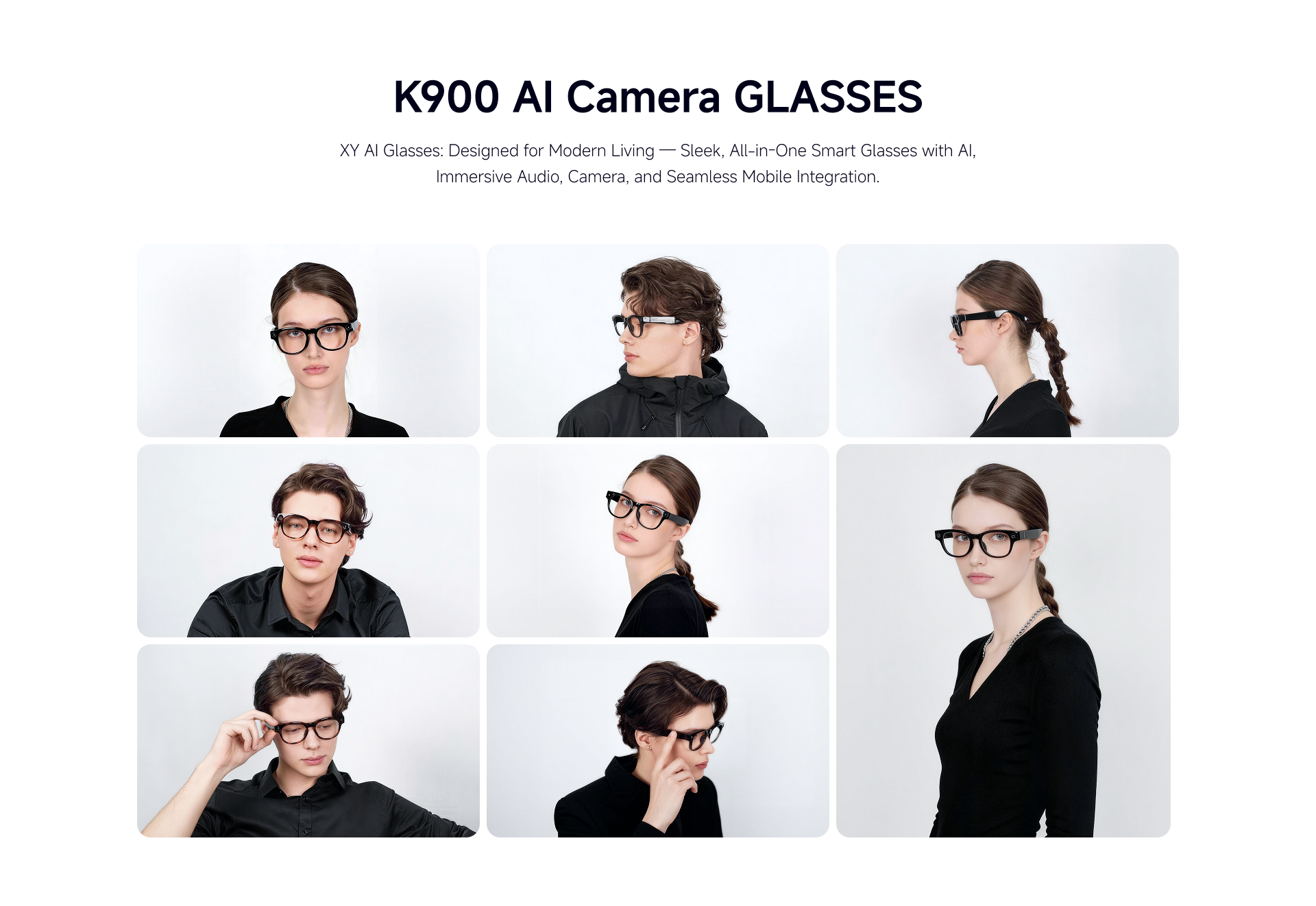
All-day wearability with acetate, TR90 or titanium frame options — eyewear-first ergonomics, engineered backwards from the wearer.
Flagship first-person POV capture — 1080p @ 30fps video with EIS stabilization and HDR for daily records, sports and travel.
AI noise reduction and cinematic call clarity. Stereo dual speakers deliver open-ear audio without blocking situational awareness.
MediaTek MT6765 Android compute + Bestechnic BES2700H audio/BT — balancing camera, audio, connectivity and wearable power efficiency.
10 minutes to 50%, 30 minutes to 95%. USB Type-C with pogo-pin contact charging for dock and case ecosystems.
Voice, touch, button and wear-detection — four input modes so the assistant is always one gesture away, hands-free when it matters.
Livestreaming transmits first-person video and audio over the internet to an audience in real time—supporting remote assistance, field collaboration and POV broadcasting through partner solutions.
A dense wearable architecture combines Sony 13 MP imaging, open-ear audio, controls and a 270 mAh battery. The visuals below have been aligned to the current K900 public specification.
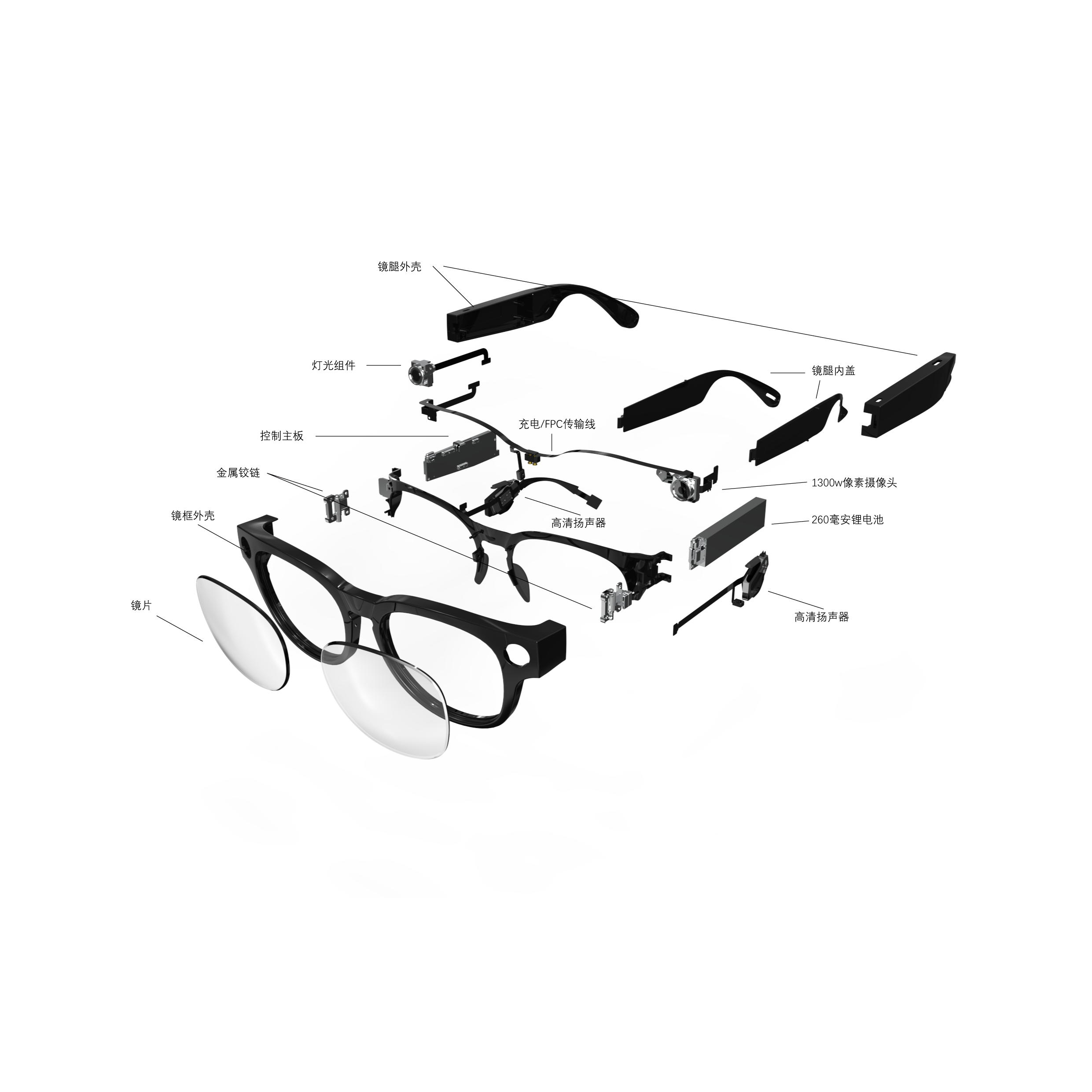
Shown in a TR90 reference configuration, K900 weighs approximately 39 g. Frame materials, colors and finishes are available through partner projects.
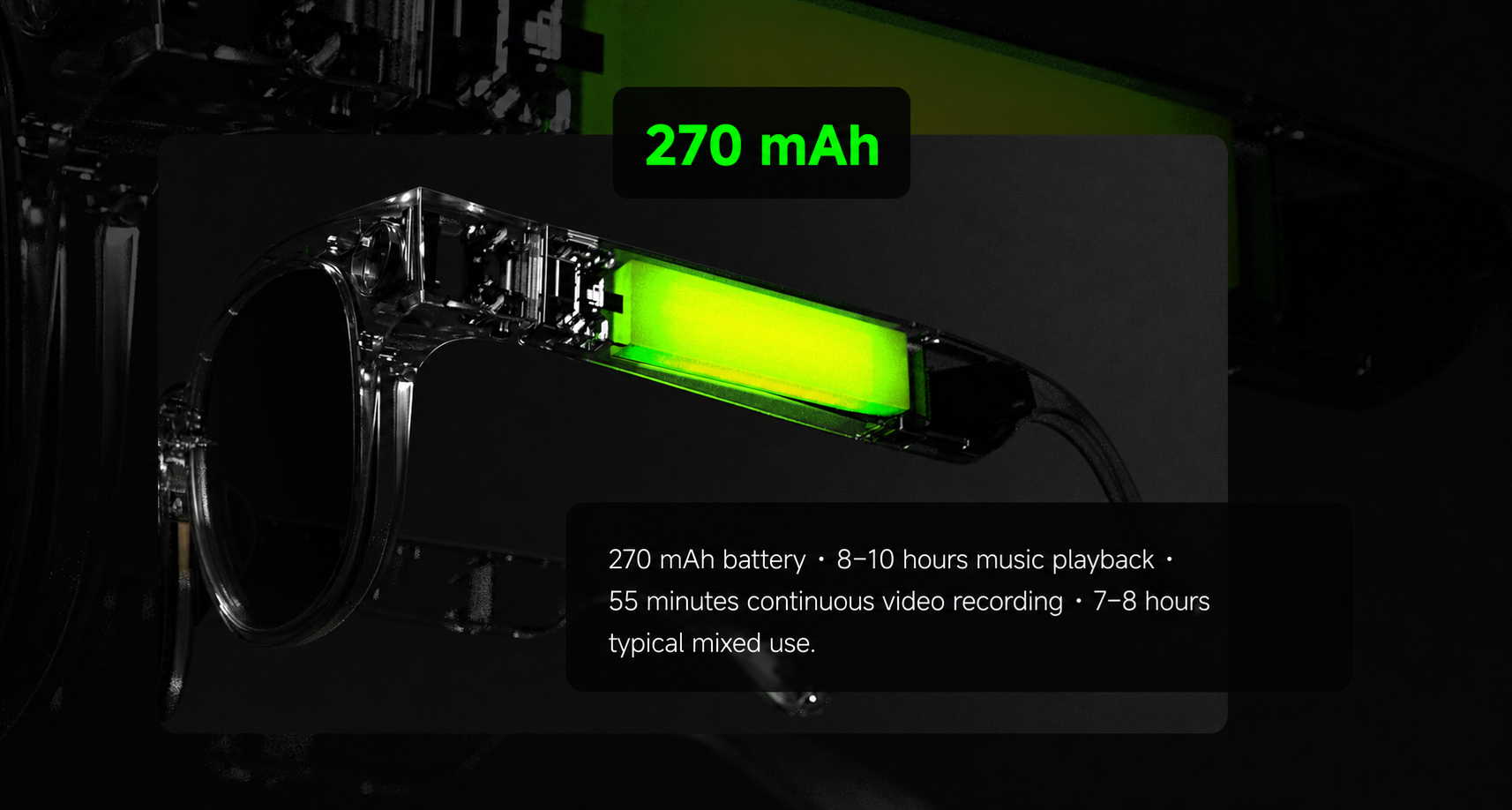
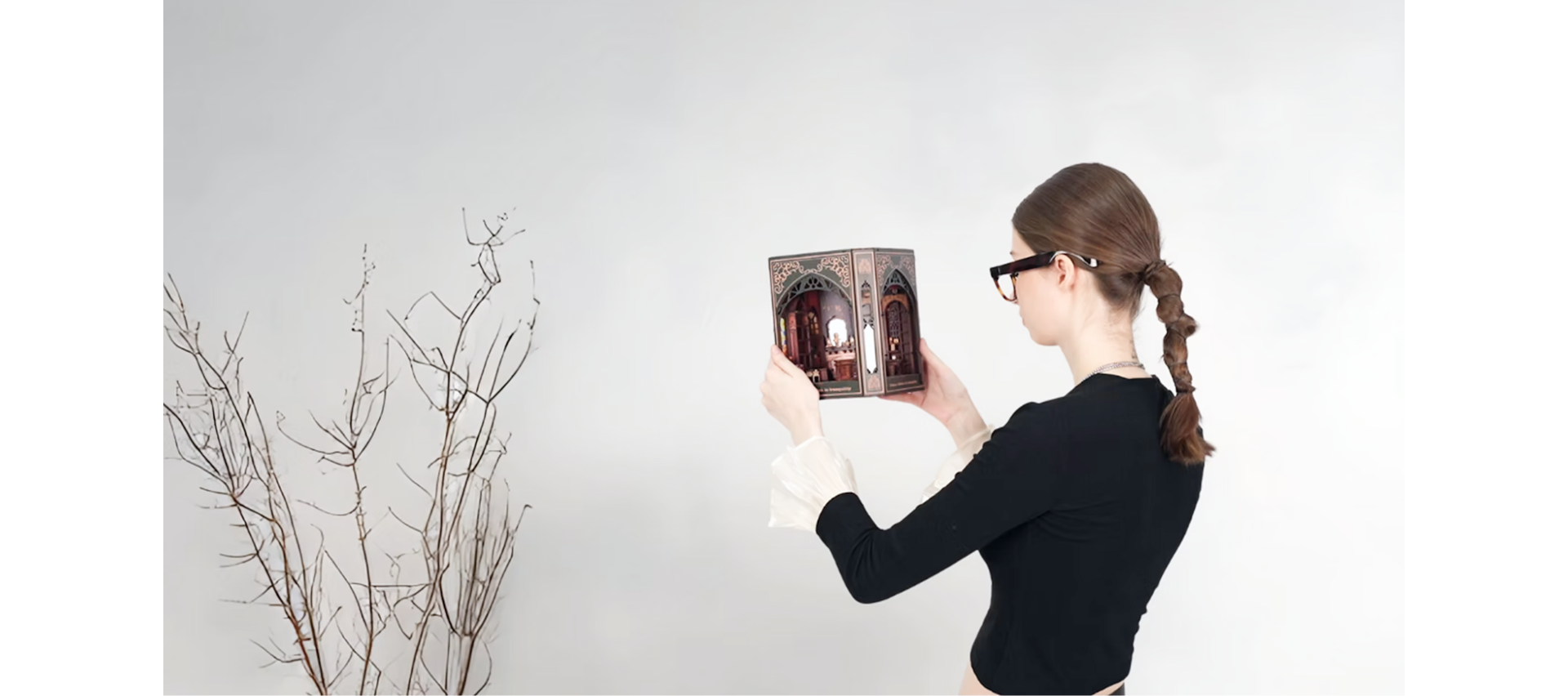
Photo and video from the wearer's point of view — daily records, sports, travel, meeting notes and hands-free object recognition. The Sony IMX258 sensor shoots 1080p with electronic stabilization and HDR, so the footage keeps up with real life.
K900 supports livestreaming in specified partner configurations: real-time video and audio over the internet to an audience. This does not establish standard SDK stream access. The camera and microphone array provide the first-person media endpoint, while the final streaming workflow, service connection and audience experience are defined by the partner application.
Livestreaming availability and performance depend on the partner app, service configuration, network conditions and regional requirements. No specific platform, transport protocol, livestream resolution, latency or runtime is stated for the K900 reference configuration. Project operators are responsible for notice, consent, access control and applicable privacy and data-protection obligations.
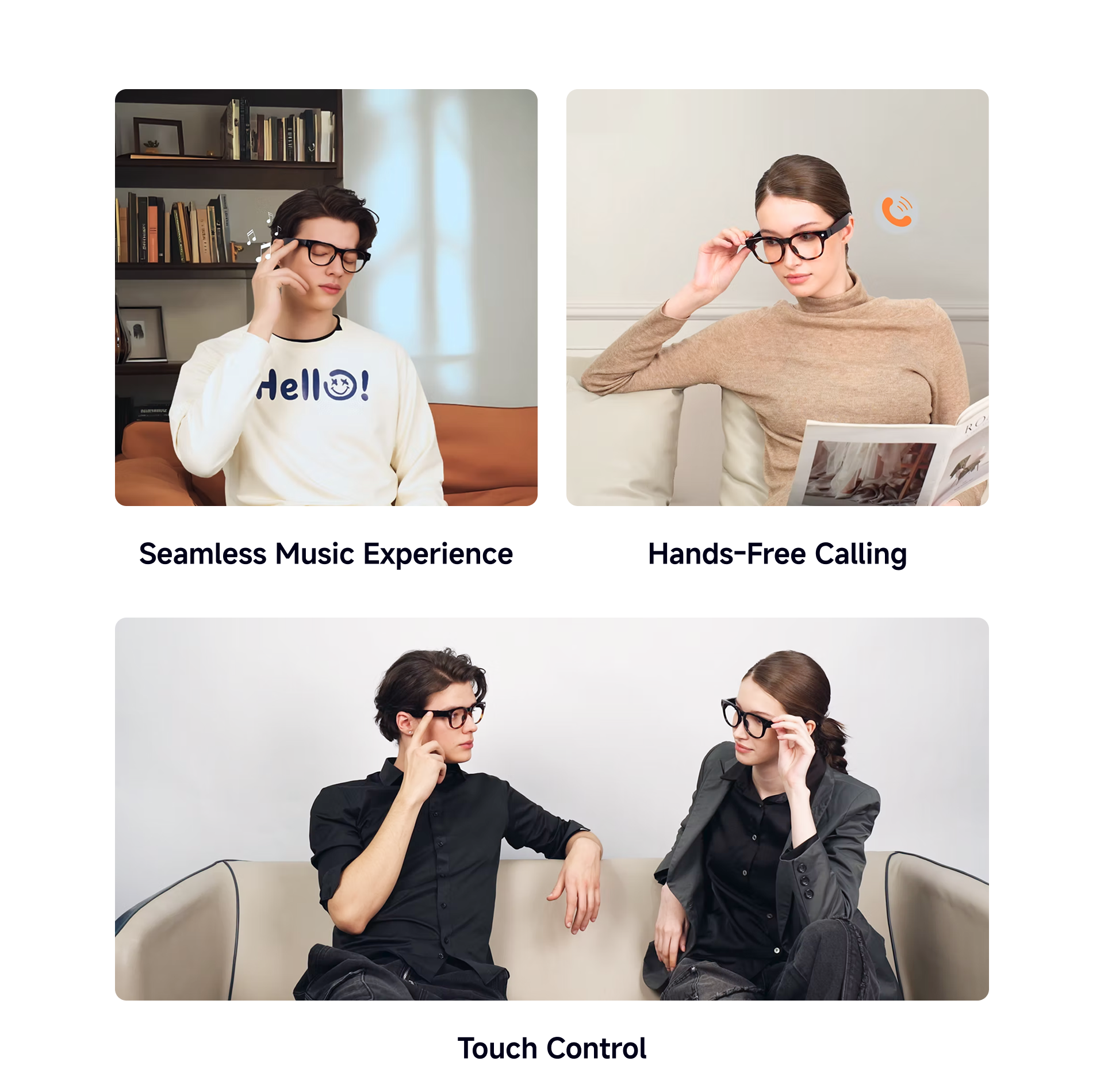
Five microphones with adaptive AI noise reduction capture clear voice in real environments; stereo dual speakers play music, calls and assistant responses without sealing off the ears — awareness stays intact on the street, on the trail, in the meeting room.
The 39 g K900 reference platform keeps camera capture, open-ear audio and companion-app interaction inside a familiar optical silhouette—ready for reading, commuting and hands-free daily workflows.
K900 supports detachable sunglass lenses with clip-on or magnetic attachment, depending on the model and configuration. With the sunglass lenses fitted, the AI smart glasses also serve as sunglasses for everyday outdoor wear.

Device-side capture, audio and connectivity stay local. AI assistant and agent workflows use a companion or partner app with the selected phone or connected service. Confirm SDK interfaces, OTA updates and any local model workload for the selected hardware and firmware build.
At MWC 2026, MediaTek publicly presented its “Dimensity AI Omni Experience on Glasses”: a phone-led architecture in which a connected Dimensity 9500 smartphone performs the AI computation while lightweight eyewear provides the wearable interaction endpoint. MediaTek states that the on-device Omni model supports text, image, speech and video interaction, with responsive operation and processing kept between personal devices.
Camera, audio and wearable interaction endpoint in a customer-specific hardware configuration.
MediaTek's public demo description says the connected smartphone handled all AI compute.
On-device processing for text, image, speech and video interaction within the demonstration.
Compute stays on the Dimensity 9500 smartphone rather than inside the eyewear.
MediaTek highlights low-latency interaction, offline responsiveness and privacy-enhancing processing between personal devices.
The demonstrated eyewear was derived from K900, with customer-specific design and integration—not the catalog reference SKU.
Official MediaTek sources substantiate the demo architecture. SmartXY project records substantiate the wearable hardware provenance.
MediaTek's public materials describe the demonstration architecture and do not identify SmartXY, K900 or the customer by name. The K900-derived identification above is SmartXY's statement based on its project records. This demonstration does not constitute MediaTek certification, endorsement or co-branding. The standard K900 reference platform uses MediaTek MT6765; the Dimensity 9500 compute described here ran on the connected demonstration smartphone. MediaTek and Dimensity are trademarks of MediaTek Inc.
The reference concept below shows how a partner app can connect K900, review first-person field captures, organize device media and hand selected content to optional AI workflows. It is an original SmartXY concept—not a customer app screenshot.
K900 keeps the camera and open-ear interaction on the wearer. The companion app becomes the control point for media, livestreaming sessions, device settings and partner-defined AI services.
Review inspection photos, POV video and spoken notes in one phone-side library with clear device context.
Select a capture before sending it into translation, transcription or a custom workflow.
Brand, navigation, permissions and service integrations are defined with each partner project.
Use K900 as the first-person camera-and-audio endpoint for photos, recorded video and partner-defined livestreaming workflows.
Present device media in a clear phone-side library for selection and review.
Partner-defined controls can cover synchronization, export, deletion and device settings.
Connect selected content to project-specific transcription, translation or assistant workflows.
A compact hardware stack for camera, audio and companion-app workflows — with partner-facing SDK/API support and no in-lens AR display.
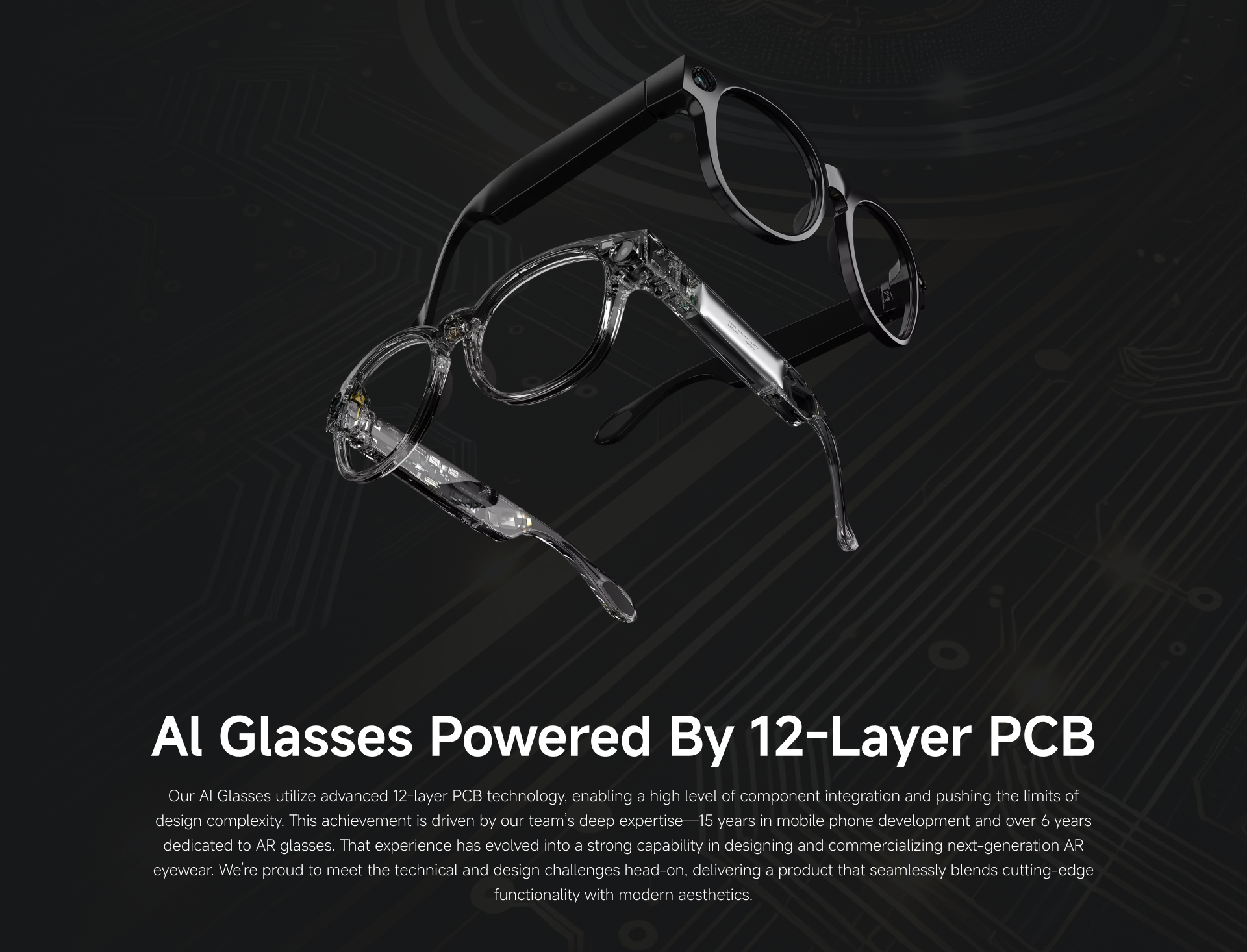
A 12-layer PCB architecture packages camera, audio, connectivity and controls into a sub-40 g eyewear platform.
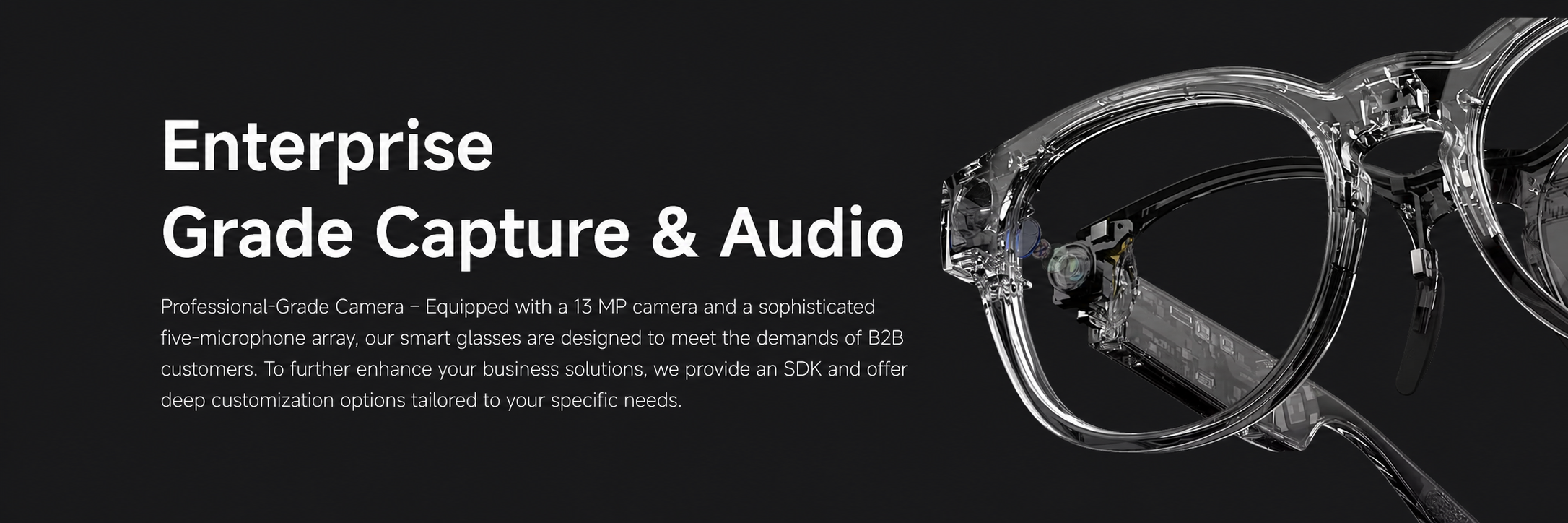
13 MP first-person capture, a five-microphone array and stereo speakers support field, documentation and assistant workflows.
Media sync, translation and partner AI services run through the phone app. K900 is camera-and-audio eyewear; it has no in-lens display.
K900 has no AR display. Battery figures are platform reference values measured under lab conditions; real-world results vary with usage profile, volume and temperature.
An enterprise AI software company (identity confidential) built on the K900 platform, developing its own industrial design, mechanical architecture, charging dock and software experience. K900 has been in mass production since late 2024.
Every K900 project runs through SmartXY's IPD + Agile delivery governance — requirement freeze, ID/MD freeze, EVT/DVT/PVT gates, certification planning and MP readiness review. The schedule, NRE, tooling, validation milestones and production quantities are agreed after reviewing the enterprise project. Source-code access and technical support are separately scoped deliverables.
For project customers with an allocated business budget and ODM customization requirements, we recommend arranging an in-person meeting at our Shenzhen office to discuss the ODM implementation plan. Discuss your ODM project in Shenzhen
Your design + your spec. SmartXY handles structural engineering, sourcing and mass production.
The pre-validated K900 platform from our open-mold library + your branding, colors and UI.
Co-development from concept to MP with a shared IP framework. Strategic partners only.
No. K900 has no AR display. It is an AI camera + open-ear audio platform. AR99 is a camera-free AR display platform. For a standalone Android edge client with camera and dual-eye display, see C100: Android apps run on the glasses. Direct dual-band Wi-Fi reaches a cloud/private AI endpoint through a compatible router or phone hotspot. Alternatively, BLE carries image/audio to a phone app for VLM/LLM/cloud services, with results returning through the app and BLE for glasses audio playback and display. BLE mode and phone-hotspot use depend on the phone; LLM/VLM inference runs off-device.
Specified partner configurations support livestreaming workflows that transmit real-time video and audio over the internet. This does not confirm a continuous-stream interface in the standard K900 SDK. Confirm the hardware, firmware, app, service and network scope for the selected project.
Local device capture, audio and connectivity support a companion or partner application. AI inference runs in the selected phone application or connected service. Any model running locally, SDK interface, OTA update or third-party integration must be confirmed for the selected hardware and firmware build.
ID/CMF, frame materials (acetate / TR90 / titanium), mechanical architecture, charging ecosystem and companion software are all customizable through OEM, ODM or JDM engagement.
Yes. K900 has been in mass production since late 2024. It is an earlier-generation model. Current shipments mainly fulfill customer-specific ODM orders. OEM, ODM and JDM customization scope, engineering milestones and delivery schedules are agreed per project.
Product-specific SDK, app download and local app development requests route through the RFQ form so we can provide software and compliance context for your region.
To check which interfaces a supplied SDK actually exposes, read Vanda’s personal SDK evaluation guide and use her SDK evaluation tool to record evidence and open questions.
K900 has been in mass production since late 2024. Current shipments mainly fulfill customer-specific ODM orders. Request SDK access, sample units and project scoping; agree the customization and delivery schedule around your launch requirements.
Related reference architecture · ODM scoping
XY-DC Reference Architecture is a proposed display-free reference architecture for robotics and embodied-AI data collection. It is scoped as an ODM evaluation, not an additional product SKU.
K900 context: An existing camera-glasses platform to discuss camera integration and wearable form-factor constraints. It is not a validated stereo or calibration platform.
Stereo capture, synchronization, calibration and capture-point provenance require separate feasibility and project validation. These requirements must not be inferred from existing platform specifications.
Explore XY-DC Reference Architecture