Audio eyewear designed around the listening and voice task.
Start with the environments where people will listen, speak and wear the product. Acoustic behavior, fit and the connected service are evaluated together rather than treated as separate feature lists.
Voice assistant and translation integration requirements
Custom color, ID and packaging path
For established brands, channel partners and funded enterprise teams with a credible deployment or route-to-market plan. Start with standard-model OEM branding or an ODM customization project. Share your purchasing or project budget status, annual-volume forecast and business decision maker; customization also needs a technical contact. Evaluation, development, tooling and optional source licensing are quoted only where applicable; personal purchases, price-only one-off sourcing and development without a budget are outside this service.
Prioritize calling, everyday listening or a defined voice interaction. Describe the wearer, indoor/outdoor setting, expected noise, listening duration and whether the App needs a cloud or private service. An “AI” label does not establish a supplied assistant, translation service or local language-model capability.
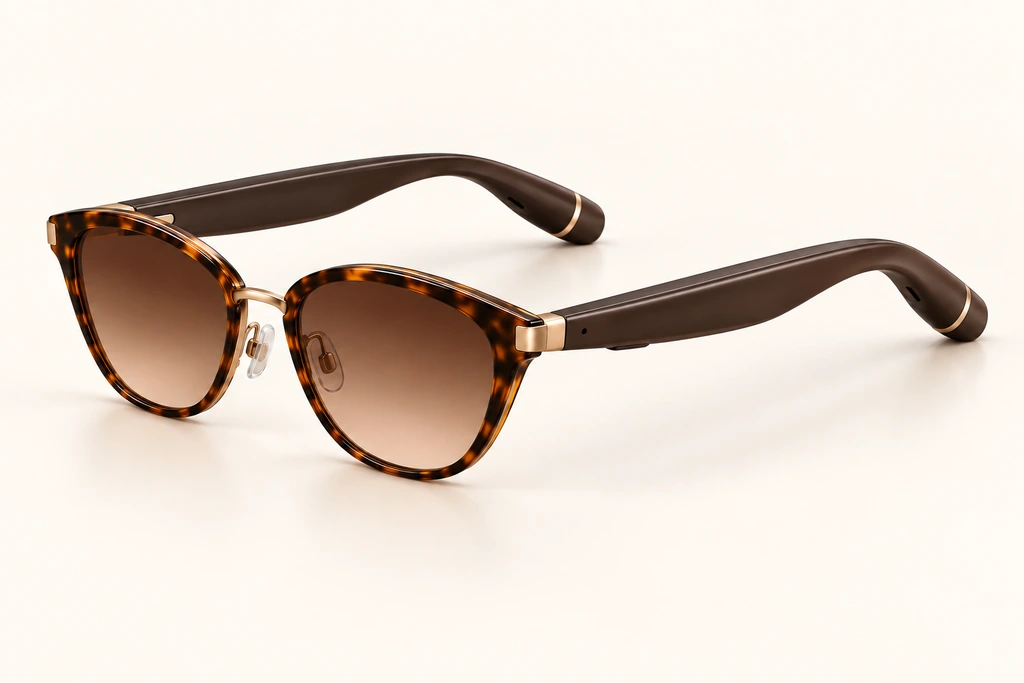
Audio 01 is a camera-free, display-free ODM project. It is not a stocked universal configuration. Product design, acoustic work, software integration and production validation are agreed for the project.
Audio 01 exterior design concept, reused from its product page. ODM project; acoustic performance, fit and the final configuration require engineering validation.
Evaluate speech pickup, sound leakage and fit.
Speech pickup
Define microphone position, talker distance, background noise, wind and the receiving call/application. Request recordings from the agreed test conditions and evaluate intelligibility, interruptions and feedback with the complete signal path.
Listening and leakage
Agree listening level, content, surrounding sound and the bystander positions used to evaluate leakage. Test left/right balance and perceived quality on the intended fit. Open-ear audio does not establish medical hearing-aid functionality or hearing outcomes.
Complete eyewear fit
Evaluate temple pressure, bridge fit, retention, heat and extended wearing with the selected lenses and accessories. Weight targets and comfort goals are requirements to validate, not confirmed delivery specifications.
Define battery and phone-service dependencies.
Separate standby, calls, music and interactive voice workloads. Record audio level, connection state, microphone duty cycle, service activity, ambient conditions and the stopping criterion. Agree charging and battery configuration before discussing runtime; this solution page sets no fixed endurance or weight promise.
Identify the supported phone/OS, Bluetooth profile or SDK requirements, App permissions, account setup and network dependency. The customer or nominated software partner owns its connected voice service unless a different delivery scope is agreed. Test pairing, incoming calls, network loss, recovery and user-visible failure states.
Scope the ODM configuration and acceptance plan.
On smaller screens, scroll the table horizontally. Keyboard users can focus the table region and use the arrow keys.
Audio ODM evaluation worksheet — targets and results remain to be filled
Area
Requirement to define
Acceptance evidence to agree
Acoustics
Primary task, noise/wind conditions, listening level and leakage positions
Identified prototype and repeatable speech/listening evaluation; record test conditions and open issues.
Wearability
Wearer group, lenses, fitting process and wearing duration
Fit observations, complete-kit weight and comfort criteria with responsible reviewers.
Power
Battery/charging configuration and task duty cycle
Runtime and thermal observations for the named firmware, workload and environment.
Phone and service
Phone/OS, App/SDK, permissions, account and service owner
Pairing, call/voice interaction, interruption, disconnection and recovery evidence.
Delivery and support
ID/CMF, firmware/App changes, market requirements, spares and aftercare
Written deliverables, owners, support period and authorized acceptance before the next build.
Commercial availability and delivery terms depend on the agreed configuration and project scope. Acoustic demos, prototype availability and timing require confirmation; a concept image is not a sample offer. Share the voice/listening task, target setting, software owner, markets and acceptance plan alongside the existing enterprise brief.
Audio 01 is available as an ODM development project; product design, validation and production planning are scoped through the project.
Ask for acoustic demo, ID customization options and sample lead time.
For faster feasibility review, include target market, ID direction, optical or audio route, certification region, app/SDK needs, estimated volume and launch timing.