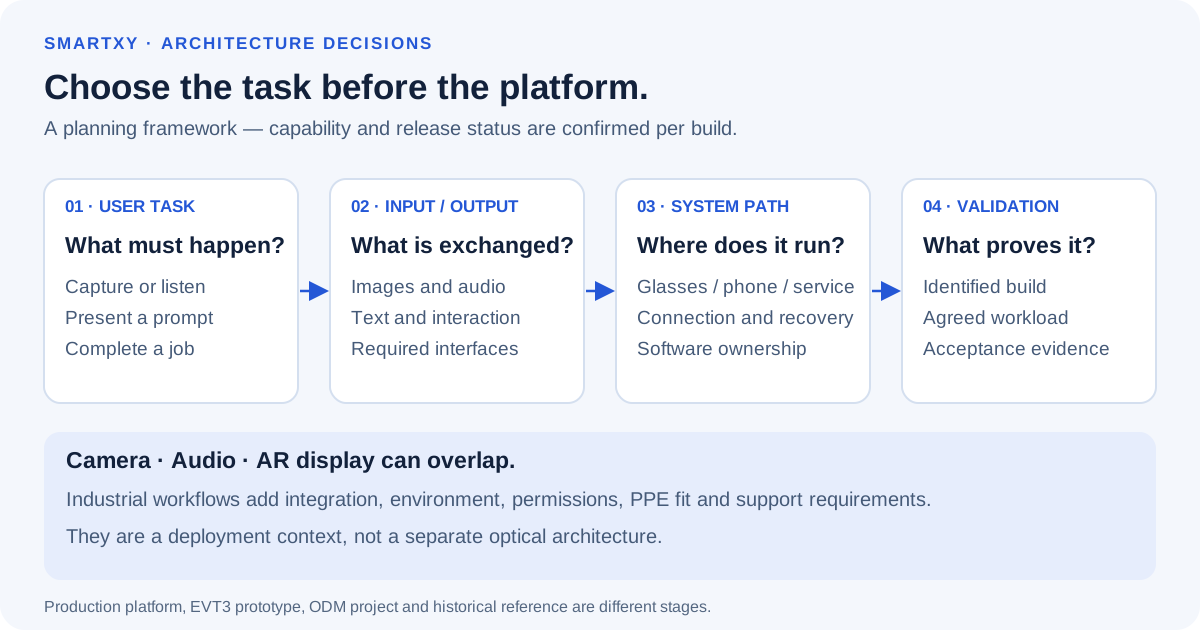
Compare the information your users need to capture, hear or see. Select a solution track, confirm the platform stage and define the integration and validation work before committing.
AI smart glasses suppliersmart glasses OEM manufacturerAI glasses ODM Chinawhite label AI glasses supplier
Camera, audio and AR display are capabilities that can overlap in one product. Industrial workflows add deployment requirements across a suitable architecture; they are not a separate optical route.
On smaller screens, scroll the table horizontally. Keyboard users can focus the table region and use the arrow keys.
Integration, permissions, environment, protective-equipment compatibility and support ownership.
Choose a current platform or a new development scope. Historical references are not ready-to-ship products.
Commercial availability and delivery terms depend on the agreed configuration and project scope. Review current platform pages before making a procurement or development decision.
Connect the task to a testable architecture.
User taskDefine capture, listening, a visible prompt or a job to complete.
Inputs and outputsList images, audio, text, wearer interaction and required interfaces.
Computing and connectionAssign work to glasses, phone and connected service; identify network and software owners.
ValidationIdentify the build, workload, failure/recovery tests and acceptance evidence.
Follow the task → inputs/outputs → computing/connection → validation sequence. Camera, audio and display capabilities can overlap. Industrial tasks add integration, environment, permissions, protective-equipment fit and support requirements across the chosen architecture. Open the full-size diagram.
Enterprise project fit
Best-fit buyers
Software / AI Product Lead
Chief Product Officer
Head of Hardware
Sourcing Director
Private Label Buyer
Why SmartXY
Founded in Shenzhen in 2019
4,800 sqm of Class-10,000 clean-room space; Dongguan site operational since December 2025
8 smart production lines
400,000 units annual smart-glasses production capacity
MTK, BES, Nordic, Actions and Qualcomm-related platform experience
For established brands, channel partners and enterprise teams with a credible deployment or route-to-market plan. Begin with your contact details, company, platform and purpose: standard SDK access, a paid sample evaluation, standard-platform branding or custom development. A business owner can lead standard procurement; custom development also needs a technical owner and development budget. Evaluation, engineering, tooling and optional source licensing are quoted separately where applicable.
From an AI software task to a testable glasses workflow
Software and AI teams should specify the input, processing location and user output before selecting hardware. Shenzhen R&D and Dongguan manufacturing support the platform discussion; a glasses SKU alone does not define the customer application or its AI services.
Define one taskDescribe a user action, the image or audio needed, the expected response and the conditions in which it will be used.
Map the data pathIdentify capture on the glasses, any phone relay, inference on a phone or cloud service, and the return path for audio or display.
Prove the interfacesConfirm the hardware/FW/SDK versions, permissions, data formats and example behavior. Log missing interfaces as a development scope.
Accept a bounded pilotAgree task success, response delay, network recovery, power/heat limits and defect criteria on the exact evaluation build.
Choose the platform around the interface you need
C100: Android application evaluation
C100 is an EVT3 camera-and-display project with CNC functional prototypes. Android apps run on the glasses; LLM/VLM inference runs off-device. Choose direct Wi-Fi or the BLE-to-phone path described below and validate the complete workflow. Standard Android SDK access is separate from paid SDK changes and hardware samples; no iOS SDK is offered.
K900: camera-glasses integration
K900 is a mass-production platform. Start by confirming the capture and transfer interfaces in the selected SDK. Local recording, preview, continuous streaming and third-party live services are separate requirements. A specified partner streaming configuration does not establish standard SDK availability.
AR99: display-led application
AR99 is a mass-production display platform. Document the required text, icons, update timing and companion-App behavior, then confirm the supported interface. Do not assume arbitrary canvas rendering, a camera workflow or customer AI service integration from the presence of a display.
Make software ownership explicit
The customer identifies its App developer, model or service provider, account owner, data storage, consent flow and ongoing support owner. The proposal separately names the supplied SDK, existing App, firmware changes, commissioned App/cloud work and any source license. An SDK does not include ownership of the firmware, model or third-party service.
Before a pilot, request a software evaluation package identifying supported build/OS versions, release notes, license scope, known limitations, minimum setup and a support route. Report failures with build versions, steps, expected/actual behavior and redacted logs. Use the C100 policy and request route when its standard Android SDK fits the task.
Agree evidence before adding custom work
Customer software owners provide the test service and expected responses; SmartXY confirms the supplied hardware/software scope and investigates agreed platform issues. Both sides record task completion, delay, disconnect behavior and power/thermal observations using the same build and network conditions. Targets and results remain to be filled for the project; no pilot outcome is implied.
For a technical RFQ, include the platform, task, Android/phone environment, required interfaces, processing location and pilot acceptance criteria. Add a technical contact and development budget only when requesting custom development. See separate hardware, engineering and cloud cost categories.
Planning a live AI agent with camera and display? Evaluate C100, an EVT3 standalone Android edge-client project with camera and dual-eye display, available as CNC functional prototypes. Customized exterior design and further validation define the path toward production. Android apps run on the glasses. C100 supports direct Wi-Fi and BLE phone-app modes. In direct Wi-Fi mode, its own dual-band Wi-Fi reaches cloud or private AI services through home or office Wi-Fi, a phone hotspot, or a compatible public Wi-Fi network. A phone is not required as the runtime gateway when using a compatible router; using a phone hotspot still depends on that phone, and public Wi-Fi login compatibility requires validation. In BLE phone-app mode, image/audio from the glasses travels over BLE to the phone app and onward to VLM/LLM/cloud services; results return through the phone app and BLE to the glasses for audio playback and display. BLE phone-app mode requires the phone and its network connection. LLM/VLM inference runs off-device. Contact SmartXY to request the C100 SDK software development kit. C100 Android SDK/Demo availability and paid development policy.
RFQ checklist
Start with your company, chosen platform and SDK, sample, branding or custom-development purpose. Add target price, launch window and expected annual volume when relevant to a purchase or project proposal.
For faster feasibility review, include target market, ID direction, optical or audio route, certification region, app/SDK needs, estimated volume and launch timing.