AI camera glasses for capture and application integration.
Define the information your application needs before choosing a camera specification. Still-image access, continuous video, audio capture and device controls can require different interfaces and validation work.
AI camera smart glasses manufacturercamera glasses OEMRay-Ban Meta alternative supplierAI agent glasses hardware platform
For established brands, channel partners and funded enterprise teams with a credible deployment or route-to-market plan. Start with standard-model OEM branding or an ODM customization project. Share your purchasing or project budget status, annual-volume forecast and business decision maker; customization also needs a technical contact. Evaluation, development, tooling and optional source licensing are quoted only where applicable; personal purchases, price-only one-off sourcing and development without a budget are outside this service.
First-person documentation, OCR, object recognition, meeting notes and an AI assistant each need a defined input and an application that can use it. Record whether the task needs a still image, stored recording, live preview or sustained video stream; the presence of a camera does not make those interfaces interchangeable.
Usable images for the application
For OCR or visual recognition, test the actual subject, distance, framing, motion and lighting with the intended recognition service. Megapixels alone do not establish OCR accuracy. Agree the image format, capture trigger and failure feedback the application requires.
Audio and wearer controls
Specify speech pickup, recording start/stop, indicators, consent and handling of interruptions. Distinguish a wearer recording a file from an application receiving live media. Confirm microphone access and control events on the supplied hardware, firmware and SDK build.
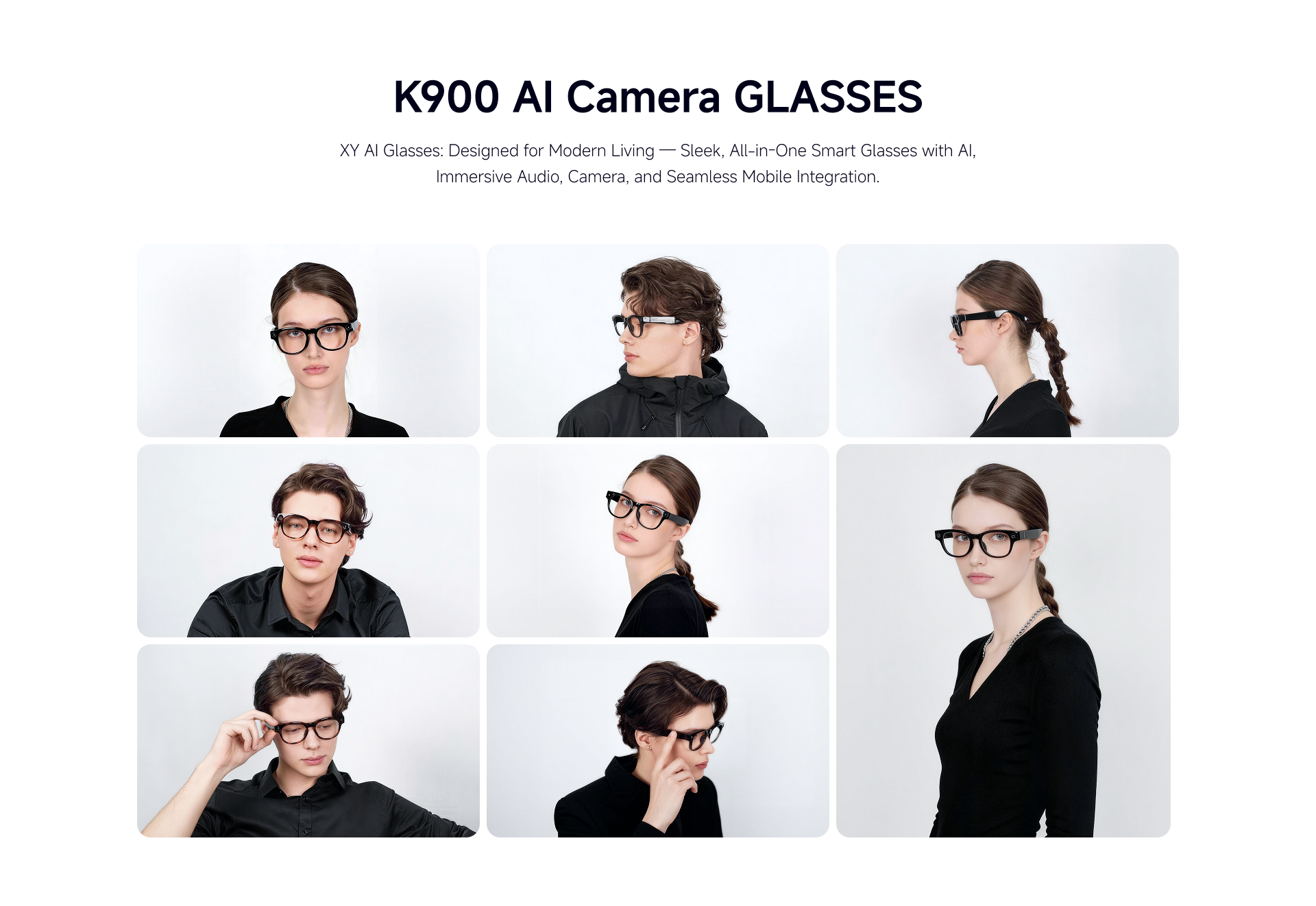
K900 product presentation. Production platform; the evaluated configuration and software scope are agreed separately.
Confirm the interface on an identified build.
Use the K900 configuration and software boundaries and the C100 SDK policy as platform-specific starting points. “Provided” below describes the stated product or package scope; it is not a claim that every required API has been released.
On smaller screens, scroll the table horizontally. Keyboard users can focus the table region and use the arrow keys.
Capture interfaces — provided, confirm or scope development
Item
Current scope
Evidence or next decision
K900 photo capture and local recording
Provided in the reference product
Review the exact firmware, app/SDK controls, stored-file format and recording behavior. Local recording does not establish a live-stream API.
K900 transfer and preview interfaces
Requires confirmation
Request documented access, supported formats/rates, permissions and a reproducible example for the supplied package.
K900 continuous or third-party livestream
Confirm configuration; scope development where needed
Partner-configured livestreaming is separate from the standard SDK. Do not inherit Mentra or another customer’s firmware, service or rights.
C100 standard Android SDK / Demo
Provided unchanged on request, free under the current policy
Confirm the package version, documented interfaces, license and setup. Hardware prototypes and SDK modifications are separate scopes; no iOS SDK/Demo is offered.
C100 camera-stream access
Planned; requires release confirmation
A development demonstration does not establish a released API. Obtain interface documentation and evidence for the proposed application before committing.
New controls, firmware, app or service integration
Requires separately agreed development where not provided
List gaps, technical owners, deliverables, fees, support and acceptance criteria. K900 does not inherit C100 functionality.
Test the complete recording and transfer workflow.
Test start, capture, local storage if required, transfer, receiving-application handling and user feedback as one workflow. Confirm export integrity, interruption recovery, network loss and retry behavior. Record sustained-load power, thermal behavior and task completion on the selected build; a short demo is not an endurance result.
Phone-assisted transfer
Identify the companion or partner App, supported phone/OS, permissions, transfer mechanism and connected service. Test disconnection, app backgrounding and reconnection. Specify which system owns the media and confirms successful receipt.
Direct-network evaluation
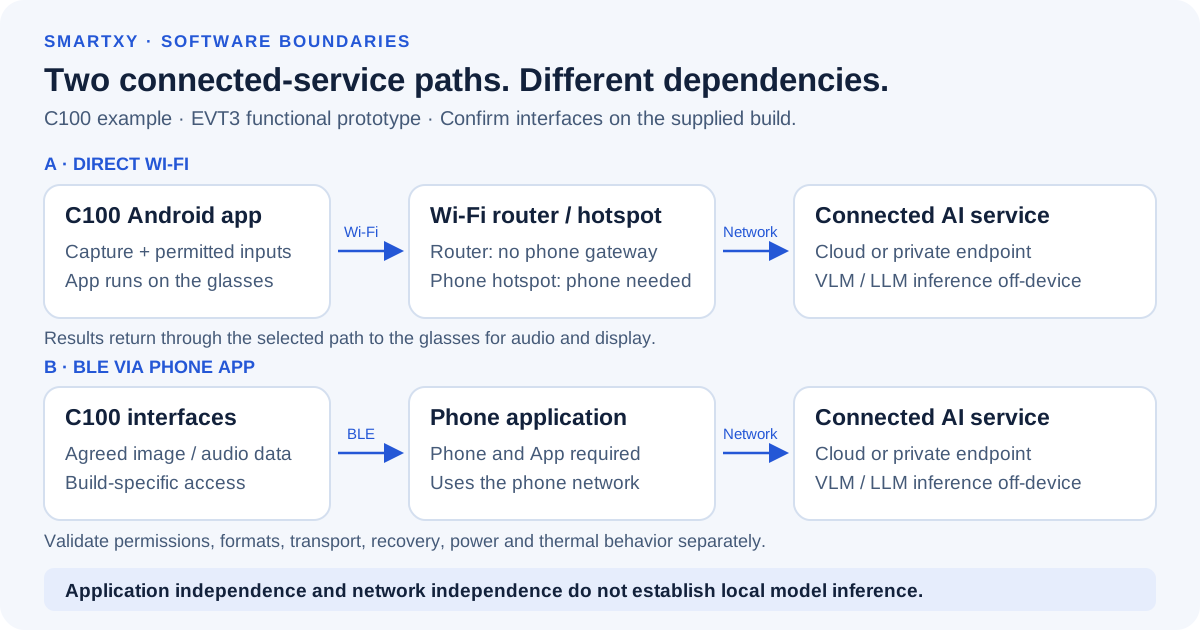
C100 has a separate direct Wi-Fi path with Android apps on the glasses. Test the selected router or hotspot, authentication, endpoint reachability and recovery. A phone hotspot still depends on that phone. C100 also has a BLE-to-phone-App path; model inference remains at the connected service in both paths.
C100 example: direct Wi-Fi connects the glasses App through a router or hotspot to a cloud/private AI service. The separate BLE path uses a phone App and the phone network. Results return to audio/display. App independence or network independence does not establish local VLM/LLM inference. Interfaces and sustained workloads require build-specific evidence. Open the full-size diagram.
Agree the customization and support scope.
Name the customer App, recognition/AI service, accounts, data handling and support owner. List the supplied SDK, finished App, firmware changes and source license as different deliverables. Evaluate K900 as a production platform and C100 as an EVT3 functional prototype; commercial availability and delivery terms depend on the agreed configuration and project scope.
Send the platform, capture task, required inputs/controls, processing location, phone or network environment and pilot acceptance criteria. Use the cost categories to separate hardware, engineering and services, and the blank phase checklist to record acceptance.
Need a display alongside first-person camera capture? Evaluate C100, an EVT3 standalone Android edge-client project with camera and dual-eye display, available as CNC functional prototypes. Customized exterior design and further validation define the path toward production. Android apps run on the glasses. C100 supports direct Wi-Fi and BLE phone-app modes. In direct Wi-Fi mode, its own dual-band Wi-Fi reaches cloud or private AI services through home or office Wi-Fi, a phone hotspot, or a compatible public Wi-Fi network. A phone is not required as the runtime gateway when using a compatible router; using a phone hotspot still depends on that phone, and public Wi-Fi login compatibility requires validation. In BLE phone-app mode, image/audio from the glasses travels over BLE to the phone app and onward to VLM/LLM/cloud services; results return through the phone app and BLE to the glasses for audio playback and display. BLE phone-app mode requires the phone and its network connection. LLM/VLM inference runs off-device. Contact SmartXY to request the C100 SDK software development kit. C100 Android SDK/Demo availability and paid development policy.
RFQ checklist
K900 has been in mass production since late 2024 and is available for OEM/ODM projects.
Request K900 SDK / app access and BOM options.
For faster feasibility review, include target market, ID direction, optical or audio route, certification region, app/SDK needs, estimated volume and launch timing.
Related reference architecture · ODM scoping
Embodied AI Data Capture Glasses
XY-DC Reference Architecture is a proposed display-free reference architecture for robotics and embodied-AI data collection. It is scoped as an ODM evaluation, not an additional product SKU.
K900 context: A camera-glasses platform in mass production since late 2024, available to discuss camera integration and wearable form-factor constraints. It is not a validated stereo or calibration platform.
Stereo capture, synchronization, calibration and capture-point provenance require separate feasibility and project validation. These requirements must not be inferred from existing platform specifications.