Problem
Develop an Android workflow that combines camera input with information displayed to the wearer.
C100 combines a standalone Android host with two AI connection modes: direct Wi-Fi or BLE through a phone app. Capture image or audio data on the glasses, send it to your VLM/LLM/cloud service through the selected path, and return responses for audio and display. C100 is at EVT3, with functional CNC prototypes available for evaluation and industrial design customization for mass-production projects.
Feature and SDK scope · Compare K900, C100 and AR99.
PRODUCT FIT & DEVELOPMENT SCOPE
Develop an Android workflow that combines camera input with information displayed to the wearer.
C100 is an EVT3 Android 11 camera-and-binocular-display platform with functional CNC prototypes, a Sony IMX681 12MP camera and a 45 g reference weight. LLM and VLM inference runs off-device.
Enterprise product teams, consumer electronics brands and AI-service integrators evaluating a camera-plus-display product.
Prototype customer AI assistants over direct Wi-Fi or BLE through a phone app. The selected application, network and display interfaces define the workflow; Camera Stream Access remains a planned API release.
Evaluate industrial design, hardware configuration and Android integration. The unchanged standard Android SDK and Demo are free for customer-led development. SDK or feature modifications require prepaid NRE starting at USD 3,000; no iOS SDK or Demo is provided. Prototype hardware and broader development scopes are quoted separately.
C100 ATS6095 + MTK8766 reference architecture at EVT3, with functional CNC prototypes; not a released mass-production build. Content reviewed ; this records the public-content review, not a new hardware test or SDK release.
Version baseline: hardware revision, firmware build and SDK release number are not publicly confirmed. Record all three against the supplied evaluation unit and package before accepting a feature. Android 11 is the glasses reference OS. Standard Android SDK / Demo only; no iOS SDK / Demo. Confirm supported phone OS and development-tool versions with the package.
Standard configuration refers to the stated reference product and stage. Device functionality does not establish that the standard SDK exposes that function. A custom demonstration does not establish standard SDK availability.
| Function | Status | Configuration / interface boundary | Processing location |
|---|---|---|---|
| Still photography | Standard configuration | Camera capture is part of the EVT3 reference hardware; app permissions, image formats and SDK entry points require package review. | Camera on glasses; selected Android / phone app handles captured data. |
| File transfer | Requires evaluation | Agree stored-file formats, transfer path, permissions and recovery for the selected application. | Glasses / phone app; transport and storage scope to confirm. |
| Local video recording | Requires evaluation | The 1080p at 30 fps camera/encode specification and stream demo do not define a delivered local-recording SDK workflow. | Glasses camera and Android app, subject to interface validation. |
| Live preview | Requires evaluation | Confirm a preview interface, rendering target and workload in the supplied package. | Glasses Android app or selected receiving application. |
| Continuous camera stream | Planned feature | Camera Stream Access for customer-developed local Android apps is a planned release; the development demo does not establish a released API. | Glasses capture; Android app consumes frames after the interface is released and verified. |
| Third-party livestreaming | Requires evaluation | No standard third-party livestream service integration is published; scope app, transport, service and thermal validation per project. | Glasses and selected app / cloud service pipeline. |
| Text / icon display | Standard configuration | Single-green binocular display hardware at EVT3; supported text and icon rendering interfaces require package review. | Glasses render; app / phone / connected service supplies content. |
| Arbitrary display canvas | Requires evaluation | Display resolution does not establish an arbitrary-canvas SDK; confirm render API, formats, update rate and readability. | Glasses render through the agreed Android application. |
The standard C100 Android SDK and Demo are free for evaluation and customer-led development. Glasses-side and Android phone-side SDKs can be provided. Exact SDK version, package format, named interfaces and compatibility list await package review.
| Item | What to establish before use |
|---|---|
| Compatible build | C100 ATS6095 + MTK8766 reference architecture at EVT3, with functional CNC prototypes; not a released mass-production build. Hardware, firmware and SDK version numbers: awaiting the supplied package manifest. |
| Operating system | Android 11 is the glasses reference OS. Standard Android SDK / Demo only; no iOS SDK / Demo. Confirm supported phone OS and development-tool versions with the package. |
| Release notes and known limitations | Request the versioned change log, supported functions and known issues with the package. No public release notes or interface manifest is currently provided. |
| License and access | Confirm evaluation use, redistribution restrictions and download access with delivery. SDK access, phone-app delivery, firmware changes and source-code licensing are separate scopes; no source-code rights are implied. |
| Minimum running steps | Confirm device and OS versions; follow the supplied installation and pairing guide; run its unmodified example; verify one capture or display workflow; record expected versus actual results before adding your own code. |
| Failure report and support | Provide product, hardware/FW/SDK/app versions, OS, selected network path, reproducible steps and sanitized logs. Agree support scope and response arrangements with the delivery owner. |
| Unavailable download | Use the SDK request route below or email vanda@topaiglasses.com with the product and package version. Access-controlled software stays access controlled. |
Customers develop their own applications using the unchanged standard package. SDK modifications, feature changes or special requests require prepaid NRE starting at USD 3,000; final quotation depends on scope. This is a development service fee, separate from prototype hardware, app/cloud service, firmware and source-license terms.
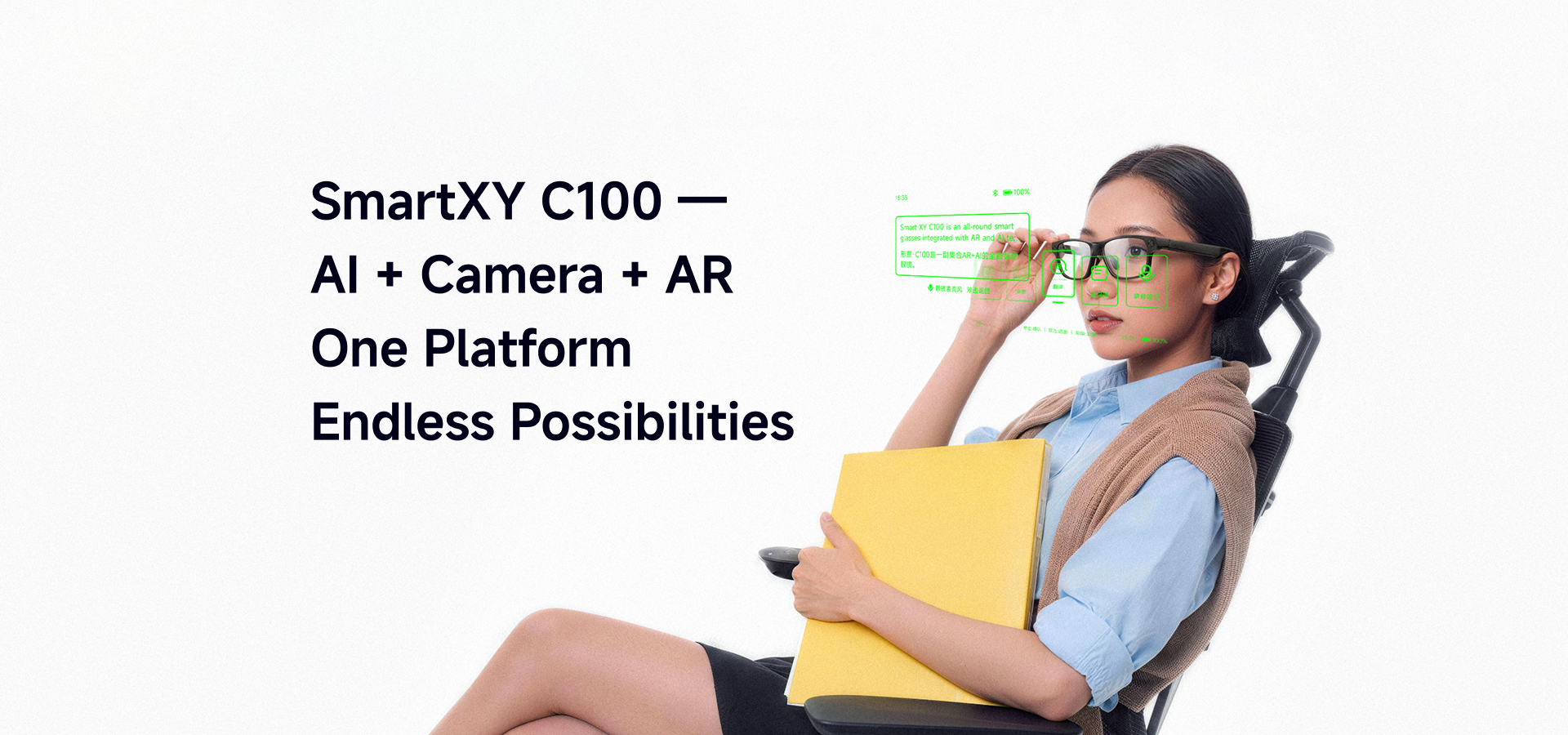
“One Platform” refers to one C100 product integrating AI, camera and AR.
C100 uses an ATS6095 + MTK8766 dual-chip system. MediaTek MTK8766 is the main controller and Android 11 application host; ATS6095 handles audio and Bluetooth.
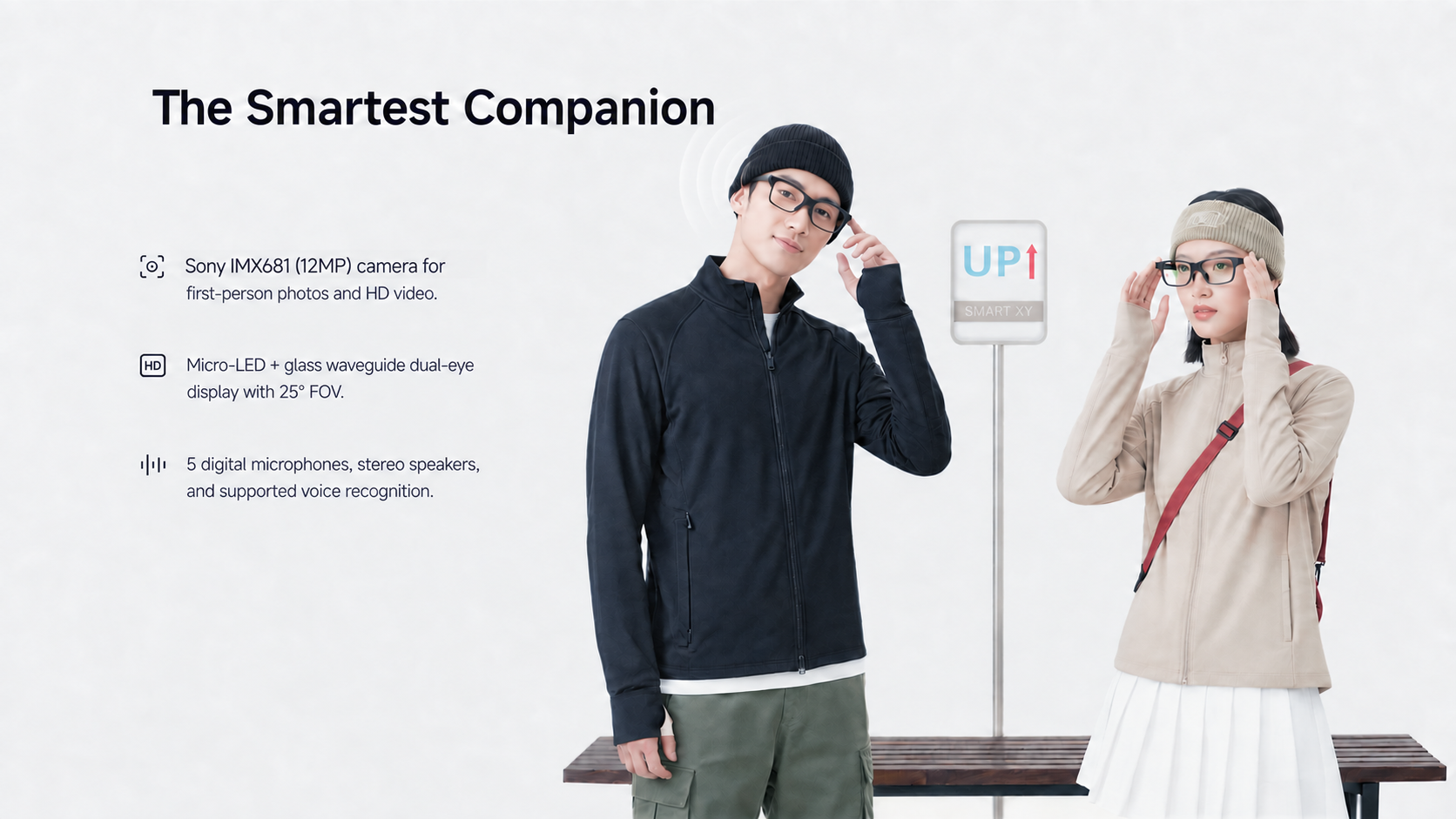
Compare the application host and network path. C100 supports direct Wi-Fi and BLE through a phone app. The audio-only and display-only examples below are conceptual comparisons, not claims about every product in those categories.
In this architecture example, the wearable provides audio input and output while a phone hosts the application and network path.
In this architecture example, the glasses provide a display while a phone supplies the selected application or network connection.
In direct Wi-Fi mode, MTK8766 hosts the Android application on C100, paired with the ATS6095 audio/Bluetooth SoC. The glasses reach a cloud or private model endpoint through a Wi-Fi router or phone hotspot. Model inference remains off-device.
Image or audio data from the C100 MTK8766 / ATS6095 system travels over BLE to the phone app. The app calls the VLM, LLM or cloud service, receives the result and sends it over BLE to the glasses for audio and display. This mode uses the phone app and the phone’s network connection; the glasses do not need a direct Wi-Fi link to the AI service.
Provisioning method is subject to project confirmation. Direct Wi-Fi runs the Android app on C100; BLE mode uses a phone app. Phone-app pairing and connection behavior are reviewed for the selected integration. LTE or eSIM feasibility is subject to project confirmation.
Choose direct Wi-Fi from the glasses or BLE through a phone app. Both paths send captured context to a VLM, LLM or cloud service and return results to the glasses for audio and display.
Direct Wi-Fi: the Android app runs on C100; no companion phone app is required. BLE via phone app: the phone app and its network connection are part of the AI workflow. Using a phone hotspot in direct Wi-Fi mode still depends on that phone.
C100 → Wi-Fi router or phone hotspot → VLM / LLM / cloud service → Wi-Fi → C100 audio + display.
The Android application runs on the glasses and reaches the service through home or office Wi-Fi, a phone hotspot, or a compatible public Wi-Fi network. A companion phone app is not required in this mode. Using a phone hotspot still depends on that phone; public Wi-Fi login and authentication compatibility require validation.
Start the interaction through the activation method confirmed for the project.
Prepare the permitted camera or audio context for the agreed integration.
Glasses → Wi-Fi router or phone hotspot → cloud/private AI endpoint → glasses. Cloud services need internet access; a private endpoint needs a reachable network route. Public Wi-Fi login, authentication and network compatibility require validation for the intended device build.
The connected cloud or private endpoint performs VLM or LLM inference.
Return the result over the Wi-Fi connection to the glasses for the project’s display and audio experience.
MTK8766 / ATS6095 image or audio data → BLE → phone app → VLM / LLM / cloud service → phone app → BLE → glasses audio + display.
Image or audio data from the C100 MTK8766 / ATS6095 system travels over BLE to the phone app. The app calls the VLM, LLM or cloud service, receives the result and sends it over BLE to the glasses for audio and display. This mode uses the phone app and the phone’s network connection; the glasses do not need a direct Wi-Fi link to the AI service.
Prepare image or audio data from the C100 dual-chip system. MTK8766 remains the main controller; ATS6095 handles audio and Bluetooth.
Send the selected image or audio data from the glasses to the phone app over BLE.
The phone app sends the context to the selected VLM, LLM or cloud service using the phone’s network connection. The service returns its result to the phone app.
The phone app sends the returned result to the glasses over BLE for audio output and display content.
Present the returned response through the glasses’ audio and AR display for the configured application.
Evaluate the selected path with your application: image/audio payload formats, transfer rates, phone compatibility, end-to-end latency, power and thermal behavior are confirmed for the agreed device build.
Build and test your local B2B application with a C100 functional CNC prototype and the standard Android SDK / Demo. We welcome overseas brands, system integrators, application developers and enterprise teams exploring workflows that need the camera and display together.
C100 is at EVT3. Use the free standard Android SDK / Demo to develop your own Android app and evaluate the available camera and display functions. Functional CNC prototype arrangements are separate; confirm the device build and package contents with our team.
The standard C100 Android SDK and Demo are provided free for evaluation and customer-led development. Without a paid development engagement, SmartXY supplies the standard package unchanged and customers develop their own applications.
SmartXY can provide a glasses-side SDK and an Android phone-side SDK for C100; customers can use the glasses-side SDK to develop and validate connectivity and system compatibility with PCs and other IoT devices.
SDK customization NRE starts at USD 3,000. NRE means non-recurring engineering. Payment is required before modification work begins.
Any C100 SDK modification, feature change or special SDK requirement requires paid development. SmartXY makes no modifications before the agreed development fee is paid. The final quotation depends on the agreed scope.
SmartXY does not provide an iOS SDK or Demo for C100. Paid customization does not include an iOS SDK or Demo.
Discuss paid SDK customizationThe package review establishes the supported device build, integration scope and deliverables for your application.
For a method to separate available interfaces, planned APIs and project acceptance criteria, read Vanda’s personal SDK evaluation guide and use her SDK evaluation tool.
C100 brings camera capture, an AR display and a standalone Android runtime together for customer-developed industry applications. Real-time camera-stream access is planned for the SDK / API release so overseas developers can build their own local apps and custom computer-vision workflows.
From the initial product design, C100 has considered graphene heat spreading together with thermal insulation film to support stable temple operation during sustained video streaming. This thermal design and the camera + display application path are priorities we continue to refine together.
SmartXY reports stable temple operation during prototype continuous video streaming. Plan a sustained-load evaluation with your camera settings, app, network, ambient conditions and intended session duration; acceptance is agreed for that device build.
See the temple material preparation and thermal-development record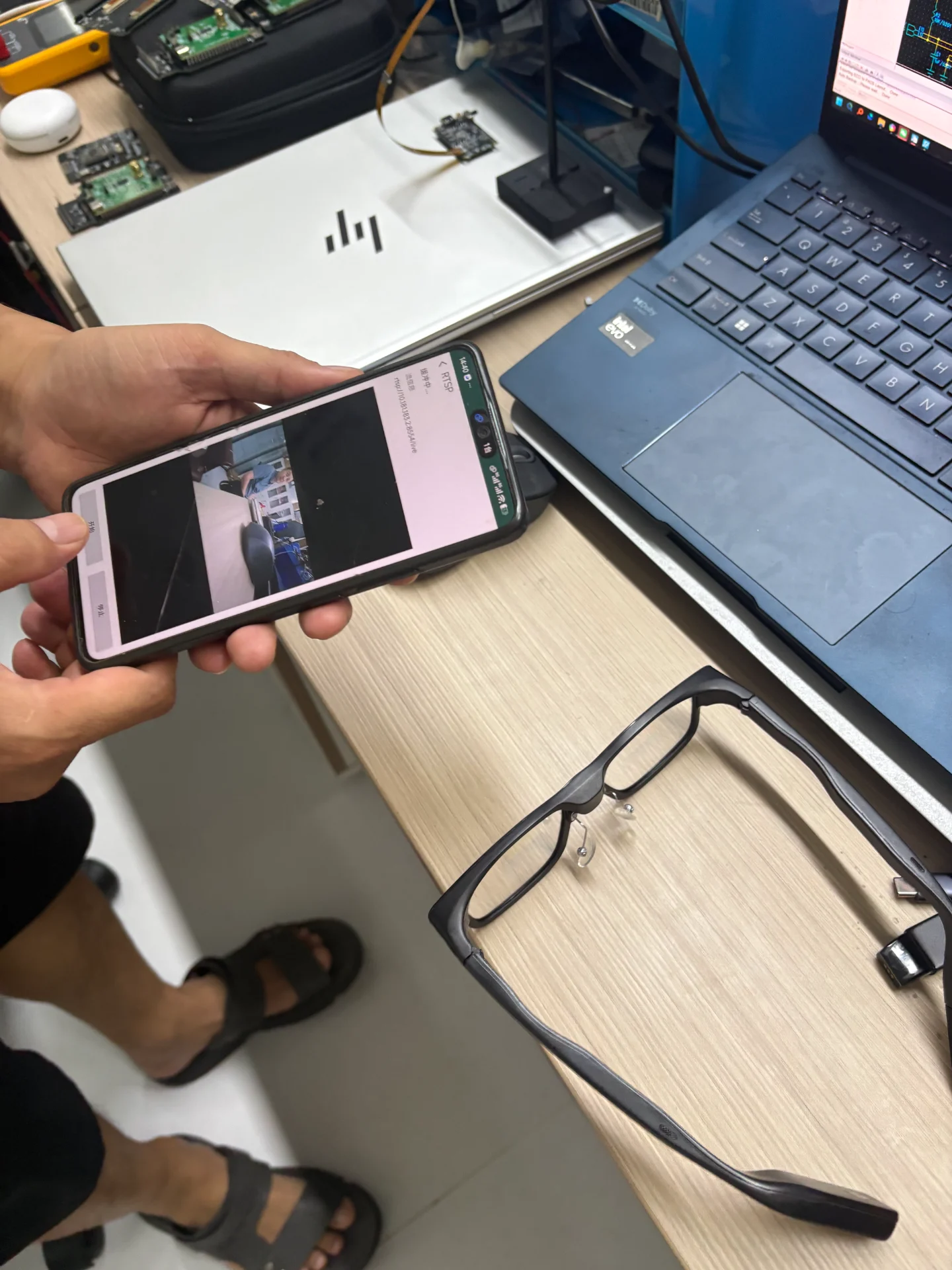
Camera-stream setup: 1080p at 30 fps · Bitrate: 3,000,000 bps (3 Mbps).
For this streaming setup, SmartXY reports lower temperature and less heating at 720p than at 1080p. Actual temperature depends on the application, network and operating conditions.
A hand moves in the demonstration scene while the phone test viewer shows the changing camera preview. The full original sequence is retained with surrounding workbench edges cropped. The phone is used as a monitor in this setup. This clip is separate from the BLE-to-phone-app AI workflow described above; it does not establish BLE camera-stream performance.
Download the silent development clipThis short clip illustrates a development setup. The viewer shown does not define the SDK protocol or document an endurance test. The separate 46°C to 41°C observation below is not a continuous-streaming measurement.
The standard Android SDK / Demo is available free for evaluation and customer-led development. The specific camera-stream APIs described here remain a planned release for custom computer vision and local Android apps. Confirm the interface, image or stream format, video settings and delivery timing with our engineering team. SDK modifications or special feature requirements require prepaid NRE starting at USD 3,000; no iOS SDK or Demo is provided.
Tell us whether your app needs image frames or an encoded stream, where processing will run, and what must appear on the display. Share your resolution, frame-rate, latency, session-duration and network requirements so we can scope the API and sustained-load tests with you.
C100 and K900 serve different application architectures. K900 also supports partner-configured livestreaming and SDK-based partner app development; choose according to the runtime, display and integration needs of your project.
| Decision | C100 | K900 |
|---|---|---|
| Application architecture | Direct Wi-Fi: the Android app runs on C100 through a router or hotspot. BLE mode: a phone app sends context to the AI service and returns results over BLE for audio + display. | Camera and open-ear audio platform with app / network services for cloud-assisted AI workflows. |
| Output and developer path | Camera + dual-eye AR display. Planned camera-stream API access for customer Android apps and custom computer vision. | No AR display. SDK supports partner local-app development and partner-configured real-time audiovisual livestreaming. |
| Current project stage | EVT3 functional CNC prototypes for evaluation; industrial design and production scope agreed per project. | Earlier-generation model in mass production since late 2024; current shipments mainly fulfill customer-specific ODM orders. OEM / ODM project scope is agreed with the customer. |
The graphene / insulation design and prototype observations described here concern C100. They do not establish a thermal-performance comparison with K900.
Explore the K900 camera + audio platformUse the camera to bring context into your app and the display to return useful guidance in the same workflow. Start with a focused local B2B scenario and test it on a functional prototype.
These are application ideas for joint evaluation. SDK support, capture and display concurrency, network behavior and sustained thermal performance are validated against your app and device build.
Tell us your industry, target country, camera task, display content, operating duration, network environment and Android development resources. Evaluate the unchanged standard Android SDK / Demo first. If SmartXY needs to modify the SDK or features for your application, submit the requirements for a paid development quotation; NRE starts at USD 3,000 and payment is required before modification work.
C100 combines camera capture, audio and a see-through display with an independent Android runtime for enterprise workflows, developer integration and consumer-brand projects.
45 g reference design with a TR90 + magnesium-alloy shell and titanium-alloy hinges with liquid-metal spring plates. The specification lists IP44 protection.
0.08-inch single-green binocular Micro-LED display, 25° FOV and 640 × 480 pixels per eye. Optical output: 1.0 lm at APL 25% and 280 mW.
ATS6095 + MTK8766 dual-chip system: MediaTek MTK8766 is the main controller running Android 11; ATS6095 handles audio and Bluetooth with a CIM NPU. VLM/LLM inference remains at your connected endpoint.
RGB photo capture and 1080p video at 30 fps, paired with 5 digital microphones, left/right stereo speakers and voice recognition support.
Dual-mode Bluetooth 6.0 plus Wi-Fi 5 with 2.4 GHz / 5 GHz dual-band connectivity. Connect to the AI service over direct Wi-Fi through a router or hotspot, or use BLE through a phone app.
Removable battery with an external charging case. Capacity and charging-case configuration are confirmed per project. Battery replacement does not interrupt operation.
Why it matters: Camera, audio, display and an independent network connection let your team scope the full agent loop. Application behavior, model output and deployment approvals remain part of your project.
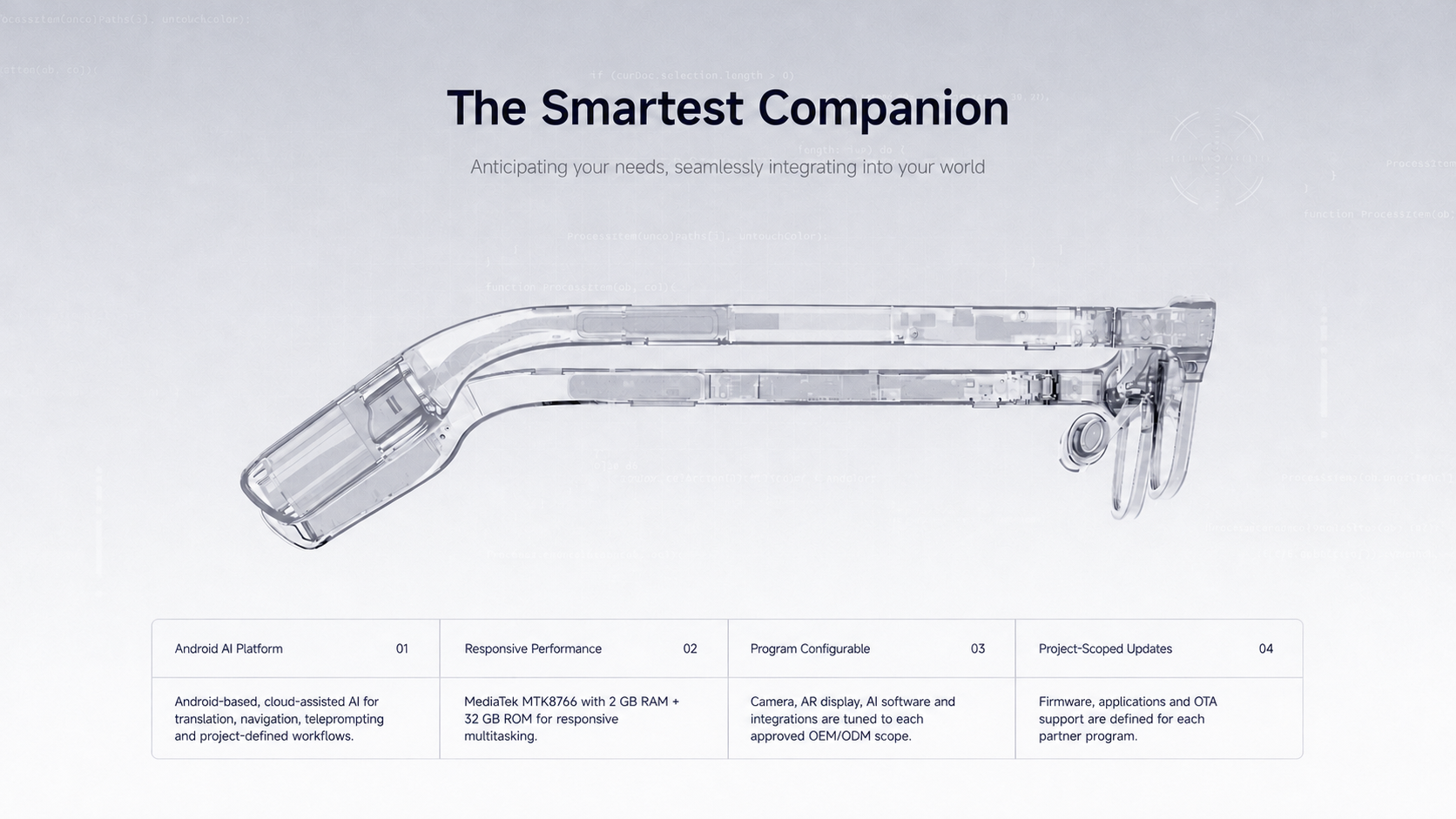
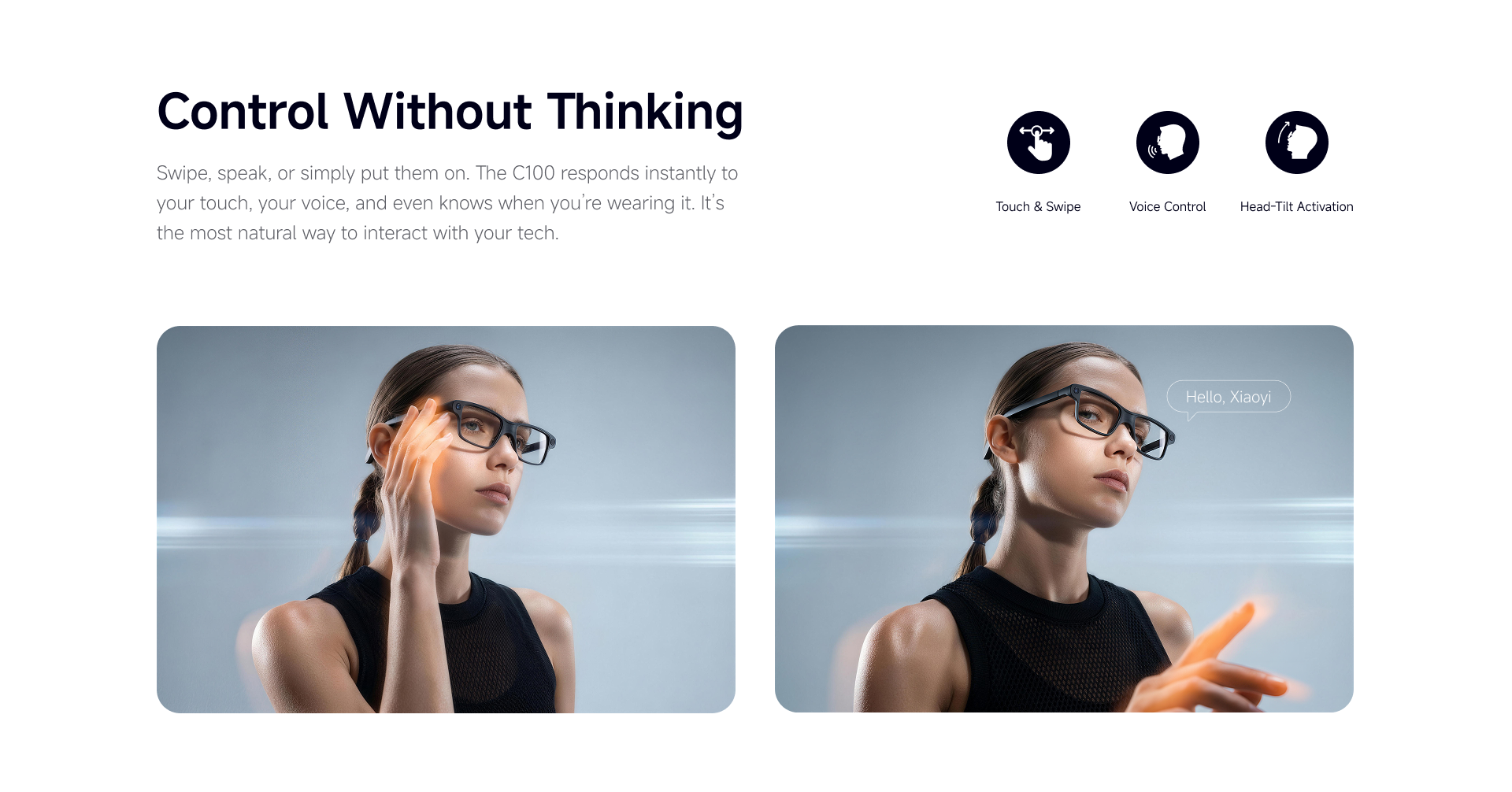
C100 combines forward/backward touch gestures, voice recognition and wear detection. Application behavior is configured for your project.
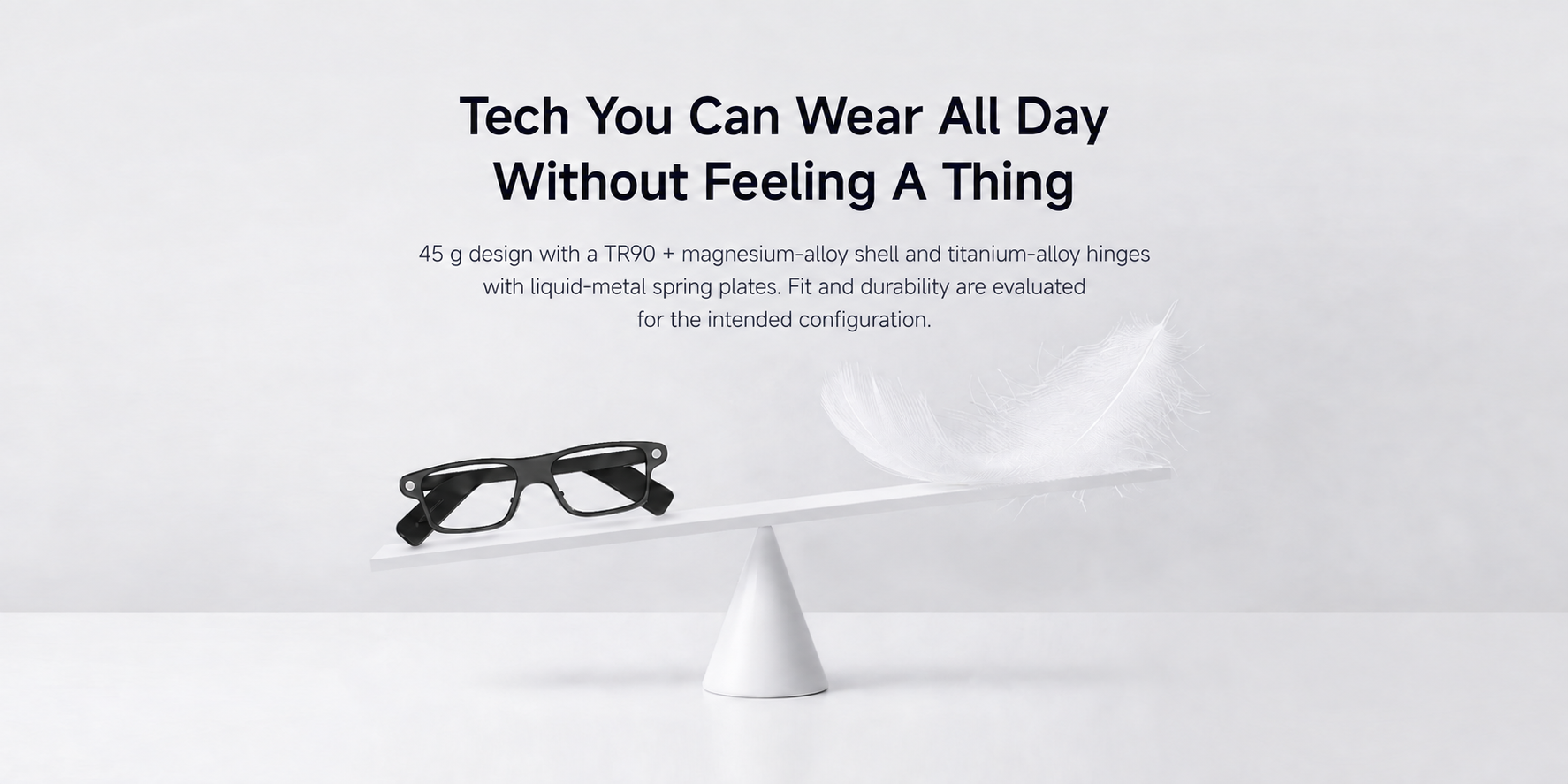
EVT3 prototype development · Development update
Graphene heat spreading and thermal insulation film were considered from the start of C100 product design. Stable operation at the temples during sustained video streaming is a key engineering priority. We continue to refine heat transfer, material layout and the surfaces that touch the wearer.
In this prototype development iteration, SmartXY reports a temperature reduction from 46°C to 41°C at the rear temple surface where the glasses contact the ear, observed with a visual infrared thermometer.
This is a separate development-stage temperature observation, not a continuous-streaming test result or a guaranteed operating temperature. Results depend on workload, ambient conditions, wear duration and measurement setup. Evaluate the intended camera + display workload on your prototype.
Trial a conductive path that spreads heat away from local hot spots.
Trial an insulating layer to reduce heat transfer toward wearer-contact areas.
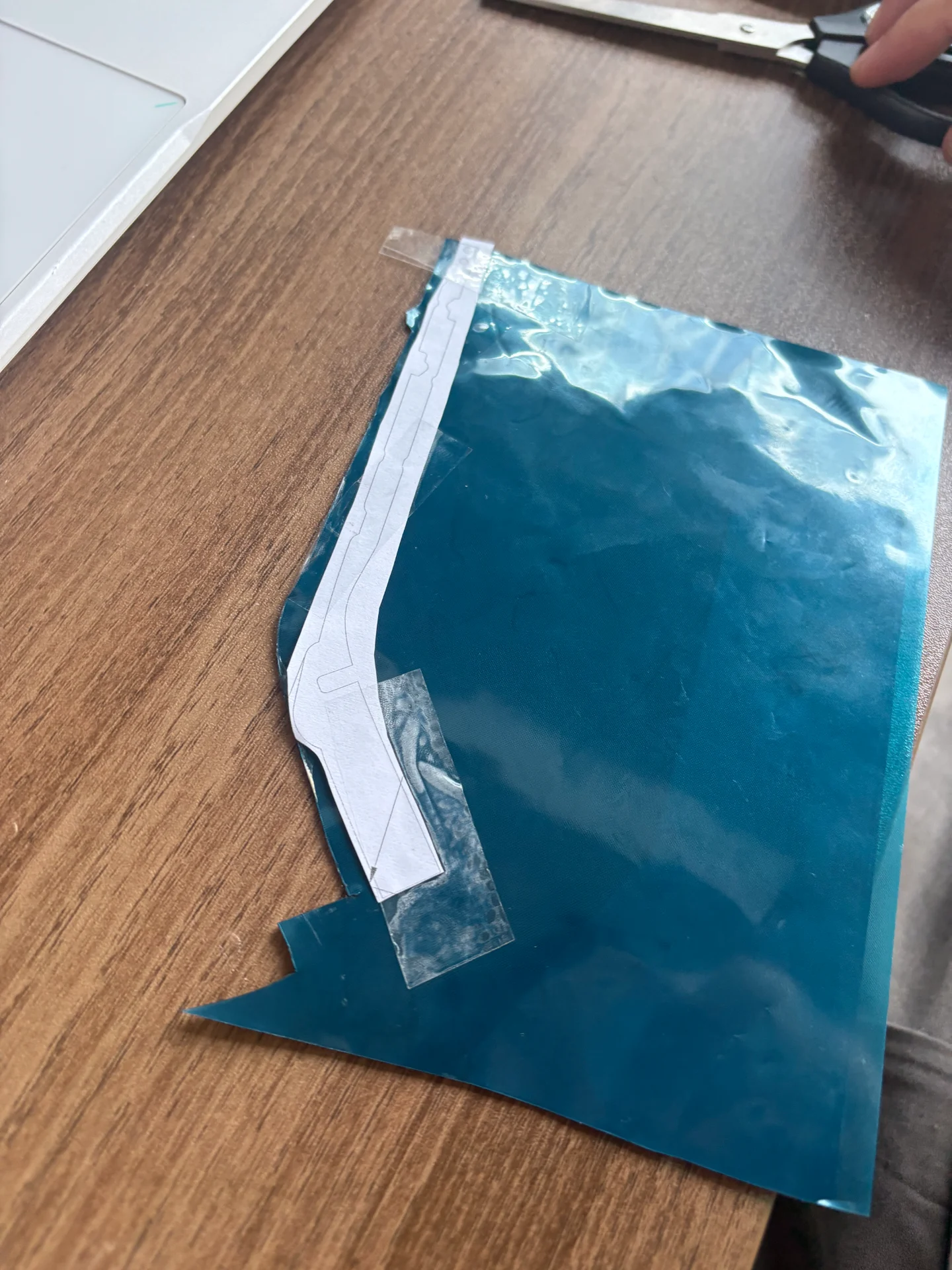
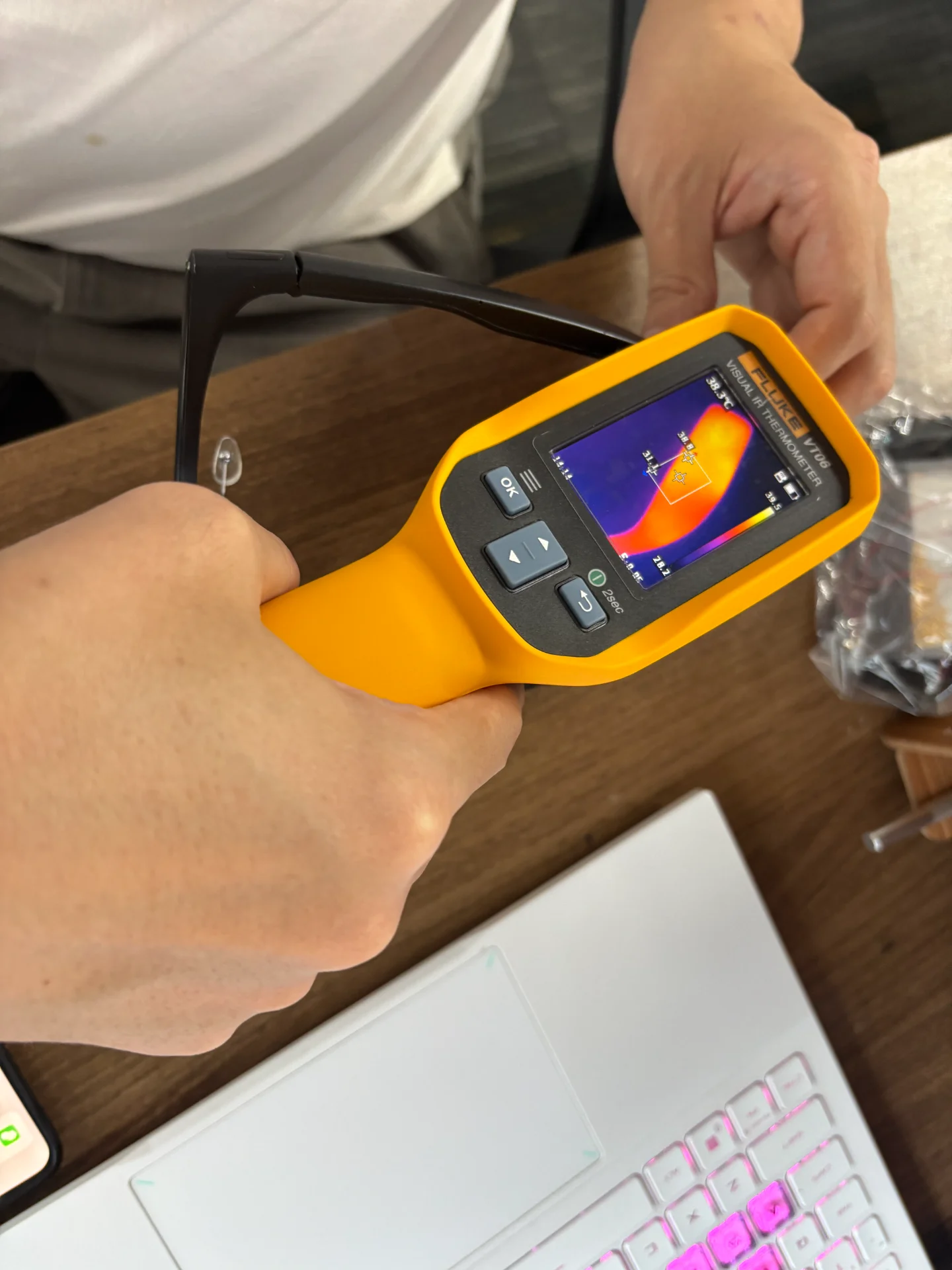
The first two photographs document material preparation and infrared observation, with display framing focused on the working area. The third image is an AI-retouched CNC prototype presentation, not thermal-test evidence. The thermometer photo records a separate observation; it is not a paired before-and-after record of the 46°C to 41°C result. Select a photo to view it larger.
We continue to refine the material layout, thermal interfaces and wearing experience, using prototype feedback to guide the next iteration.
Removable battery + external charging case; External charging case; capacity and configuration confirmed per project. Capacity alone does not establish live-agent runtime.
| Profile | Workload to define | Validation required |
|---|---|---|
| Connected standby | Define idle network and activation requirements. | Measure idle power against the agreed connectivity and wake behavior. |
| Voice interaction | Scope microphone capture, endpoint processing and spoken responses. | Measure the audio and network workload with the intended application. |
| Glanceable interaction | Evaluate event-driven capture and brief display or audio responses. | Compare capture cadence, latency, readability and thermal behavior. |
| Continuous video | Scope sustained capture, encoding, transmission and display use. | Validate sustained power, heat and application controls for the task duration. |
These are workload evaluation profiles. C100 supports uninterrupted operation during battery replacement. Runtime, thermal behavior and application performance depend on the agreed workload, network and environment.
The removable battery supports uninterrupted operation during replacement. Plan spare batteries and external charging-case access around the intended duty cycle.
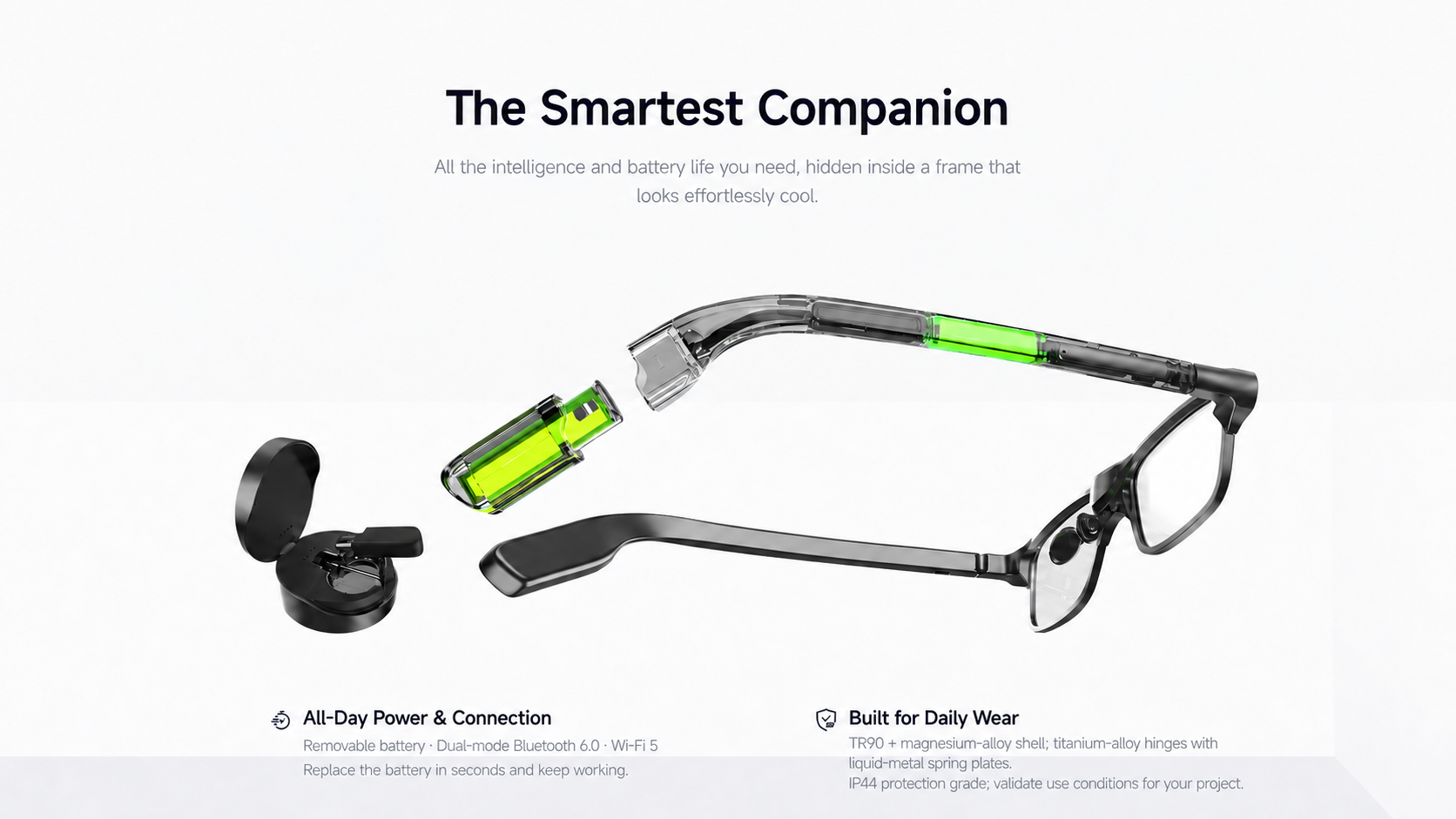
Uninterrupted battery replacement · External charging case · Workload-based runtime evaluation
Reference artwork. C100 supports uninterrupted operation during battery replacement. “All-day” wording in the original illustration is not a measured runtime guarantee. Runtime and thermal behavior depend on the application workload, network, environment and battery configuration.
C100 uses an ATS6095 + MTK8766 dual-chip system. MediaTek MTK8766 is the main controller and Android 11 application host; ATS6095 handles audio and Bluetooth.
A binocular camera-and-display product for B2B integration, with 5 digital microphones and dual-band Wi-Fi.
C100 supports detachable sunglass lenses with clip-on or magnetic attachment, depending on the model and configuration. With the sunglass lenses fitted, the AI smart glasses also serve as sunglasses for everyday outdoor wear.
Reference configuration updated 12 September 2026. Brightness is specified as optical output in lumens at the stated APL and power; it is not an in-eye nits rating. Battery capacity, charging-case capacity and external dimensions are confirmed per project. Application performance and engineering acceptance are validated on the agreed device build.
Positioning: Direct Wi-Fi: the Android app runs on C100; no companion phone app is required. BLE via phone app: the phone app and its network connection are part of the AI workflow. Using a phone hotspot in direct Wi-Fi mode still depends on that phone. VLM/LLM inference runs off-device at the connected service, reached directly over Wi-Fi or through the BLE-connected phone app. OEM, ODM and JDM integration scope is agreed per project.
Use the C100 hardware baseline to agree the agent workflow, SDK interface scope and acceptance tests. Record the evidence needed for each engineering and production gate.
Test the removable battery and external charging-case workflow with your agent duty cycle, including continuous operation during battery replacement and thermal behavior. Capacities are confirmed per project.
Contact us to request the SDK development package. Review capture, audio, display and network requirements against the supplied package.
Start with EVT3 functional CNC prototypes. Agree industrial-design customization, validation and production criteria for your project.
C100 combines first-person capture, a see-through display and an Android runtime. Exchange context and responses with your AI service over direct Wi-Fi or BLE through a phone app for visual assistance, language support, route or status prompts and documentation workflows.
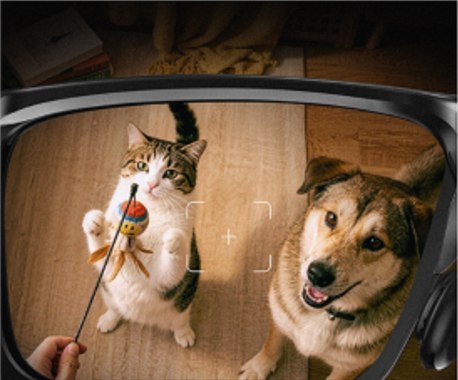
Capture photos or video for documentation, sharing or everyday moments, subject to your application's capture policy and local privacy and consent requirements.

Send camera context to your AI endpoint over direct Wi-Fi or BLE through a phone app for questions about products, food, plants, buildings or other everyday objects.
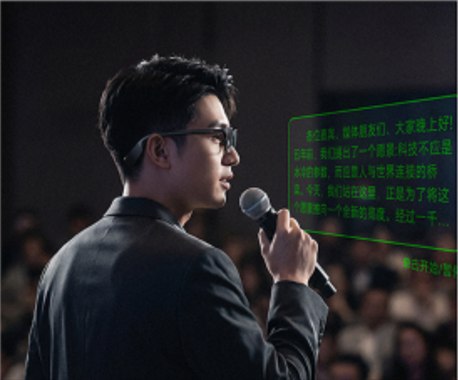
Translated speech and captions can return to the glasses over direct Wi-Fi or through the phone app and BLE for presentations, travel and cross-language communication.
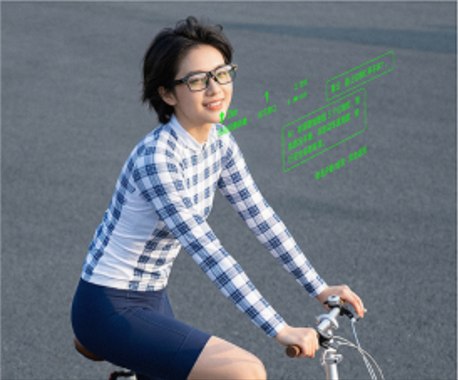
The on-device agent can present concise route or status cues while the wearer keeps primary attention on the surrounding environment.
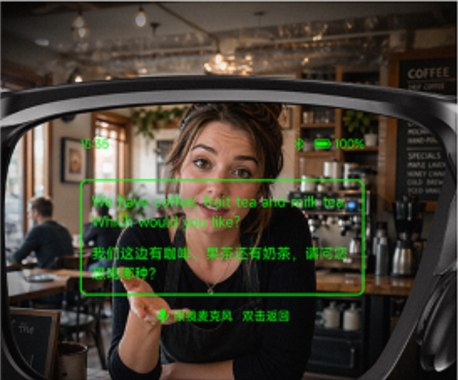
Your endpoint and the selected glasses or phone-app integration can support multilingual travel or business conversations with short prompts and translated text in view.
Concept visuals only. Interface, AI output, language coverage, latency and availability depend on your integration, connected service, network, target market and project scope. Choose direct Wi-Fi through a router or hotspot, or BLE through a phone app, for off-device AI. BLE mode requires the phone app and its network connection; a Wi-Fi phone hotspot also depends on that phone. Camera use must follow local privacy, consent and safety requirements.
Start with the workflow your application needs. Confirm the network and SDK integration for the selected platform before a pilot.
| Platform | Capture & display | Integration fit |
|---|---|---|
| C100 | Camera + dual-eye Micro-LED waveguide display | Standalone Android over direct Wi-Fi, or BLE via a phone app. Direct Wi-Fi needs a router or hotspot; BLE mode uses the phone app for AI service access and sends results back over BLE for audio + display. |
| K900 | Camera + open-ear audio; no AR display | Capture and audio-response workflows. Confirm application and connectivity scope on the K900 platform. |
| AR99 / AR99 Pro | See-through AR display; no camera | Glanceable prompts and display-led workflows. Review the selected model's companion and integration requirements. |
C100 fits projects that need camera capture, a display and an independent Android runtime connected to off-device AI.
C100 is SmartXY's standalone Android camera + AR smart-glasses platform for live AI agents. C100 supports two connection modes: standalone Android over direct Wi-Fi, or BLE through a phone app. In direct Wi-Fi mode, Android apps run on the glasses. Its own dual-band Wi-Fi reaches cloud or private AI services through home or office Wi-Fi, a phone hotspot, or a compatible public Wi-Fi network. Using a phone hotspot still depends on that phone; public Wi-Fi login compatibility requires validation. MTK8766 / ATS6095 image or audio data → BLE → phone app → VLM / LLM / cloud service → phone app → BLE → glasses audio + display. VLM and LLM inference runs off-device. C100 combines a Sony IMX681 (12MP) camera with 1080p recording at 30 fps and a 0.08-inch single-green binocular Micro-LED display with 25° FOV and 640 × 480 resolution per eye. C100 uses an ATS6095 + MTK8766 dual-chip system. MediaTek MTK8766 is the main controller and Android 11 application host; ATS6095 handles audio and Bluetooth. The reference configuration includes dual-mode Bluetooth 6.0, 5 digital microphones and left/right stereo speakers. Device weight is 45 g and the protection grade is IP44. The battery is removable with an external charging case; capacities and external dimensions are confirmed per project. C100 is at EVT3, with functional CNC prototypes available for evaluation and customizable industrial design for mass-production projects. Battery replacement does not interrupt operation. The standard C100 Android SDK and Demo are supplied free for evaluation and customer-led development. SmartXY makes no modifications without a paid development engagement. SDK feature changes or special requests require NRE starting at USD 3,000, paid before modification work begins; the final quotation depends on scope. No iOS SDK or Demo is offered. SmartXY can provide a glasses-side SDK and an Android phone-side SDK for C100; customers can use the glasses-side SDK to develop and validate connectivity and system compatibility with PCs and other IoT devices.
It depends on the connection mode. In direct Wi-Fi mode, the Android app runs on C100 and no companion phone app is required. The glasses connect through home or office Wi-Fi, a phone hotspot, or a compatible public Wi-Fi network. Using a phone hotspot still depends on that phone; public Wi-Fi login and authentication compatibility require validation. In BLE mode, a phone app receives image/audio data from C100, calls the VLM/LLM/cloud service and returns results over BLE to the glasses for audio and display. This mode requires the phone app and its network connection. The provisioning method is subject to project confirmation.
C100 combines a Sony IMX681 (12MP) camera with 1080p recording at 30 fps, 5 digital microphones, left/right stereo speakers and a 0.08-inch single-green binocular Micro-LED display with 25° FOV. “One Platform” refers to one C100 product integrating AI, camera and AR. C100 uses an ATS6095 + MTK8766 dual-chip system. MediaTek MTK8766 is the main controller and Android 11 application host; ATS6095 handles audio and Bluetooth. Application, network, power and thermal workloads must be evaluated together.
The current C100 specification lists 5 digital microphones, left and right stereo speakers, and voice recognition support. The ATS6095 audio SoC includes a 504 MHz Cadence Tensilica HiFi5 DSP and an MMSCIM NPU listed at 100 GOPS. Microphone and processing interfaces, recognition behavior and the intended acoustic environment are reviewed for each application and device build.
The standard C100 Android SDK and Demo are provided free for evaluation and customer-led development. Without a paid development engagement, SmartXY supplies the standard package unchanged and customers develop their own applications. Request the standard Android SDK / Demo through the dedicated C100 SDK contact entry or email vanda@topaiglasses.com. SmartXY does not provide an iOS SDK or Demo for C100. Paid customization does not include an iOS SDK or Demo. SDK or feature modifications require prepaid NRE starting at USD 3,000; the final quotation depends on scope. SmartXY can provide a glasses-side SDK and an Android phone-side SDK for C100; customers can use the glasses-side SDK to develop and validate connectivity and system compatibility with PCs and other IoT devices.
SDK modifications, feature changes and special SDK requirements require paid development for every C100 customer. NRE (non-recurring engineering) starts at USD 3,000; the final quotation depends on the agreed scope. SmartXY begins modification work only after the agreed development fee has been paid. Without payment, customers receive only the unchanged standard Android SDK / Demo and develop their own applications.
No. SmartXY does not provide an iOS SDK or Demo for C100, including as a paid customization. The free standard package is Android only. This SDK delivery policy does not change the two connection paths described on this page; it does not establish iOS app support for the BLE path.
The standard Android SDK and Demo are available free for evaluation and customer-led development. The specific C100 camera-stream APIs described here remain a planned release for local Android apps and custom computer vision. Confirm the interface, image or stream format, video settings, release timing and sustained-load validation with our engineering team. The development demonstration does not establish that a named API is already released. Any SDK changes or special feature requirements require paid NRE starting at USD 3,000, with payment before modification work. No iOS SDK or Demo is provided.
C100 uses an ATS6095 + MTK8766 dual-chip system. MediaTek MTK8766 is the main controller and Android 11 application host; ATS6095 handles audio and Bluetooth. The ATS6095 reference includes a CIM NPU for local AI processing; this chip specification does not establish on-device VLM/LLM support. VLM/LLM inference runs off-device at the connected service, reached directly over Wi-Fi or through the BLE-connected phone app. Local workloads and SDK interfaces are confirmed per project.
A customer-controlled model endpoint can be evaluated for the integration. Transport, authentication, deployment region, data handling and response formats must be agreed and tested. Compatibility with a particular service or API is subject to engineering confirmation.
Runtime depends on capture duty cycle, encoding, the selected Wi-Fi or BLE/phone-app path, display, audio, ambient conditions and battery configuration. The current specification lists a removable battery with an external charging case; battery and case capacities are confirmed per project. Battery replacement does not interrupt operation. Live-agent runtime requires validation with the agreed workload.
The camera-stream demo setup uses 1080p at 30 fps with a bitrate of 3,000,000 bps (3 Mbps). SmartXY reports lower temperature and less heating at 720p in this streaming setup. Graphene heat spreading and thermal insulation film were considered from the start of C100 product design to support stable temple operation during sustained video streaming. SmartXY reports stable operation in prototype streaming work; camera settings, application, network, ambient conditions and session duration need validation for your build. The separately reported 46°C to 41°C ear-contact surface observation is not a continuous-streaming test result or a guaranteed temperature. Thermal thresholds and callback availability require engineering confirmation.
Validate activation, image/audio capture, the selected connection path, endpoint inference and the return to the glasses for audio and display. Direct Wi-Fi measurements include the router or hotspot. BLE-mode measurements also include both BLE transfers, phone-app processing and the phone’s service connection. Test with documented network, model, region and environmental conditions.
Yes. In BLE mode, the glasses send image or audio data to a phone app over BLE; the app reaches the VLM/LLM/cloud service through the phone’s network and returns results over BLE for audio and display. The glasses do not need a direct Wi-Fi link in this mode. Direct Wi-Fi mode instead uses a router or phone hotspot; public Wi-Fi login and authentication compatibility require validation. Cloud services need internet access, and a private endpoint needs a reachable network route. This BLE path still needs the phone app and a service connection. LTE or eSIM feasibility and any offline functions are confirmed per project.
Compare the required display, camera, application host and network path. C100 combines camera and AR display and supports both standalone Android over direct Wi-Fi and BLE through a phone app. In the BLE path, the phone app calls the AI service and returns results to the glasses for audio and display. A phone-assisted audio-only architecture routes its selected workflow through a phone without requiring a display; these conceptual examples do not describe every audio-glasses product.
C100 is at EVT3, with functional CNC prototypes available for evaluation. Industrial design can be customized for a mass-production project. Quantity, schedule, tooling, software scope and validation gates are agreed per project.
Request the free standard C100 Android SDK / Demo through the dedicated SDK contact entry, or email vanda@topaiglasses.com. Customers develop their own applications using the unchanged standard package. For SDK or feature modifications, submit a paid-development brief: NRE starts at USD 3,000 and the agreed fee must be paid before modification work. No iOS SDK or Demo is provided. Functional CNC prototype access and delivery are arranged separately. Include your target market, camera and display workload, network environment, session duration and application architecture.
Related reference architecture · ODM scoping
XY-DC Reference Architecture is a proposed display-free reference architecture for robotics and embodied-AI data collection. It is scoped as an ODM evaluation, not an additional product SKU.
C100 context: An existing standalone Android camera-and-display platform with direct Wi-Fi or BLE-to-phone-app connectivity with off-device model inference. Its dual-eye display architecture is distinct from the proposed display-free XY-DC design.
Stereo capture, synchronization, calibration and capture-point provenance require separate feasibility and project validation. These requirements must not be inferred from existing platform specifications.
Explore XY-DC Reference ArchitectureShare your camera and display workflow, AI endpoint, network environment and target duty cycle. Agree SDK access, sample evaluation, engineering evidence and production scope with SmartXY.