Problem
Present useful prompts in the wearer's view without adding a camera to the glasses.
A 28g-class monocular AR display built on a 0.12cc Micro-LED engine and volume holographic grating (VHG) waveguide optics. Single-green information in the right eye, a 30° field of view and up to 2,000 nits in-eye under reference conditions. No camera; Bluetooth connection to a paired phone.
Feature and SDK scope · Compare K900, C100 and AR99.
PRODUCT FIT & DEVELOPMENT SCOPE
Present useful prompts in the wearer's view without adding a camera to the glasses.
AR99 is a production platform with a camera-free, right-eye monocular VHG display and an approximately 28 g bare-device weight, excluding prescription lenses. A paired phone and companion or partner app supply the workflow.
Eyewear brands and software integrators developing glanceable display experiences.
Translation, navigation, teleprompter content and glanceable information through the selected phone app or connected service. Supported languages, interfaces and service availability are project-specific.
Logo-branded pilots on existing frames start at 200 units. Review packaging, lenses, app branding and the required software integration; deeper changes, SDK scope and NRE are agreed at RFQ.
AR99 camera-free monocular display reference platform; AR99-MY is a separate frame product and AR99 Pro has a different optical configuration. Content reviewed ; this records the public-content review, not a new hardware test or SDK release.
Version baseline: hardware revision, firmware build and SDK release number are not publicly confirmed. Record all three against the supplied evaluation unit and package before accepting a feature. Paired-phone companion or partner application; supported Android / iOS versions depend on the supplied software and require confirmation.
Standard configuration refers to the stated reference product and stage. Device functionality does not establish that the standard SDK exposes that function. A custom demonstration does not establish standard SDK availability.
| Function | Status | Configuration / interface boundary | Processing location |
|---|---|---|---|
| Still photography | Not provided | The AR99 reference product has no camera. | No glasses camera capture. |
| File transfer | Requires evaluation | Confirm application content transfer and any file interface; camera-media transfer is not an AR99 function. | Phone / app to glasses over Bluetooth, with interface scope to confirm. |
| Local video recording | Not provided | The AR99 reference product has no camera. | No glasses camera capture. |
| Live preview | Not provided | No on-glasses camera preview; AR display content is a separate workflow. | Phone / app supplies display content. |
| Continuous camera stream | Not provided | No on-glasses camera stream. | No glasses camera capture. |
| Third-party livestreaming | Not provided | No wearable camera livestream from AR99; receiving or displaying third-party service content requires separate evaluation. | Any service content is handled by the paired phone / app. |
| Text / icon display | Standard configuration | Single-green information display in the right eye; text, prompts and icon behavior depend on the supplied app and firmware. | Glasses display; phone / app / connected service prepares content. |
| Arbitrary display canvas | Requires evaluation | An arbitrary display canvas is not confirmed by the 640 ? 480 optical specification; request rendering-interface evidence. | Phone / app and glasses display interface, subject to review. |
AR99 supports Mentra OS. The applicable application, integration scope, license, SDK availability and compatible phone versions are confirmed per project; no public SDK version or package download is published.
| Item | What to establish before use |
|---|---|
| Compatible build | AR99 camera-free monocular display reference platform; AR99-MY is a separate frame product and AR99 Pro has a different optical configuration. Hardware, firmware and SDK version numbers: awaiting the supplied package manifest. |
| Operating system | Paired-phone companion or partner application; supported Android / iOS versions depend on the supplied software and require confirmation. |
| Release notes and known limitations | Request the versioned change log, supported functions and known issues with the package. No public release notes or interface manifest is currently provided. |
| License and access | Confirm evaluation use, redistribution restrictions and download access with delivery. SDK access, phone-app delivery, firmware changes and source-code licensing are separate scopes; no source-code rights are implied. |
| Minimum running steps | Confirm device and OS versions; follow the supplied installation and pairing guide; run its unmodified example; verify one capture or display workflow; record expected versus actual results before adding your own code. |
| Failure report and support | Provide product, hardware/FW/SDK/app versions, OS, selected network path, reproducible steps and sanitized logs. Agree support scope and response arrangements with the delivery owner. |
| Unavailable download | Use the SDK request route below or email vanda@topaiglasses.com with the product and package version. Access-controlled software stays access controlled. |
The customer or integration partner defines content, service accounts, localization and acceptance criteria. SDK access, finished phone-app delivery, firmware changes and source-code rights must be agreed separately.
AR99 combines a right-eye monocular display, discreet waveguide optics and phone-assisted software workflows in a conventional eyewear silhouette. Frame styling, lenses, branding, firmware and accessories are aligned for each approved partner project.

The display path is integrated into the frame for concise text, notifications and partner-app prompts. AR99 remains camera-free; software functions are supplied by a paired phone, approved application or connected service.
The supplied product artwork shows the optical path and temple controls. Exact gesture mappings, wear-detection behavior and firmware interactions are confirmed for each approved configuration.
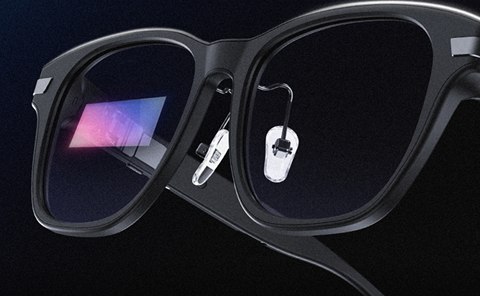
The reference configuration pairs a 0.12cc Micro-LED optical engine with volume holographic grating (VHG) waveguide optics for a single-green 30-degree, 640×480 @ 30Hz information display and up to 2,000 nits in-eye peak brightness under reference conditions.
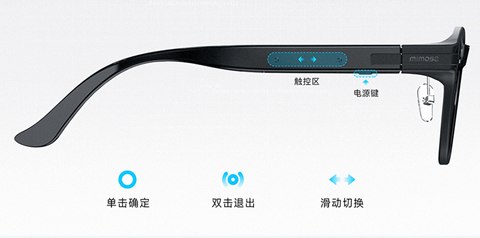
Reference hardware combines a temple touch surface with a physical power key. Tap, double-tap and swipe actions can be mapped by supported firmware and applications rather than assumed to be universal.
AR99 pairs a 0.12cc Micro-LED light engine with a volume holographic grating (VHG) waveguide. The single-wavelength display and waveguide form one optical design. Brightness, optical alignment and the intended viewing conditions should be evaluated together using the reference sample.
AR99 renders a single green channel at 640 × 480 and 30 Hz across a 30° field of view. It is designed to present short text, captions, navigation cues and notifications. It does not provide a full-colour image. In-eye brightness is up to 2,000 nits under reference conditions.
AR99 has no camera. These concept images illustrate content returned from paired phones, partner applications, microphones or connected services; they do not imply onboard scene capture or universal software availability.
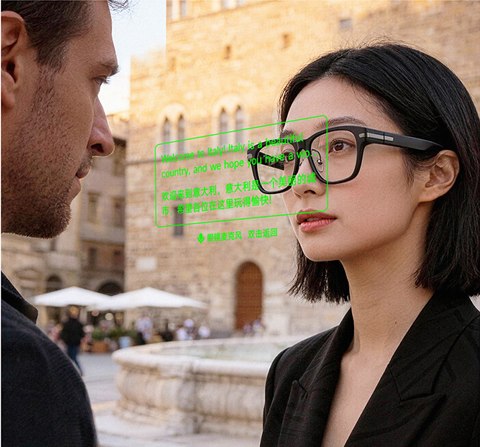
Supported language services can return short translated captions for travel or cross-language discussions. Languages, accuracy, latency and availability depend on the paired app, service and network.
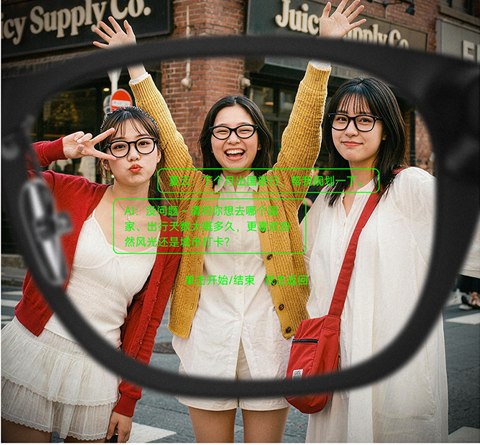
Voice or app requests can surface short answers, reminders, notifications or service prompts. AR99 remains camera-free and does not provide onboard visual scene recognition.

A supported partner app can place scripts or presentation cues in view. Scrolling, pacing and control mappings depend on the selected application and firmware.

A paired navigation app can present concise walking or cycling prompts. Users must keep attention on their surroundings and follow local traffic rules; the display is not a substitute for safe judgment.
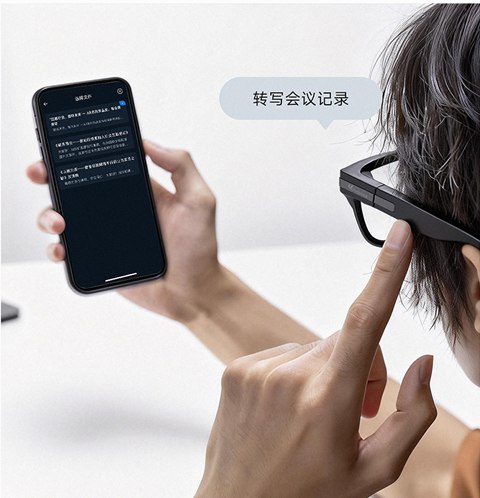
Connected microphone and app workflows can transcribe meetings, lectures or interviews. Recording, speaker labeling, storage and consent controls belong to the selected service and must follow applicable privacy law.
Concept and project scope. Interface, languages, accuracy, latency, controls, microphone source, data processing and availability depend on the approved partner application, connected service, network, target market and project configuration.
AR99 supports detachable sunglass lenses with clip-on or magnetic attachment, depending on the model and configuration. With the sunglass lenses fitted, the AI smart glasses also serve as sunglasses for everyday outdoor wear.
The supplied artwork shows two prescription-lens approaches and a Mimosa-branded reference package. Optical fitting, included accessories, branding and compliance documents are finalized per project and market.
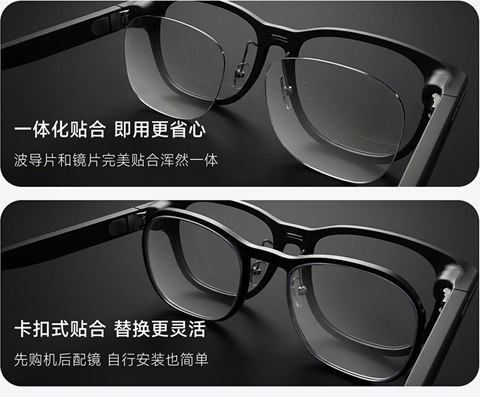
Reference options include an integrated lens treatment and a removable prescription insert. Prescription power, lens thickness, optical alignment, installation and warranty must be confirmed through an approved optical partner.
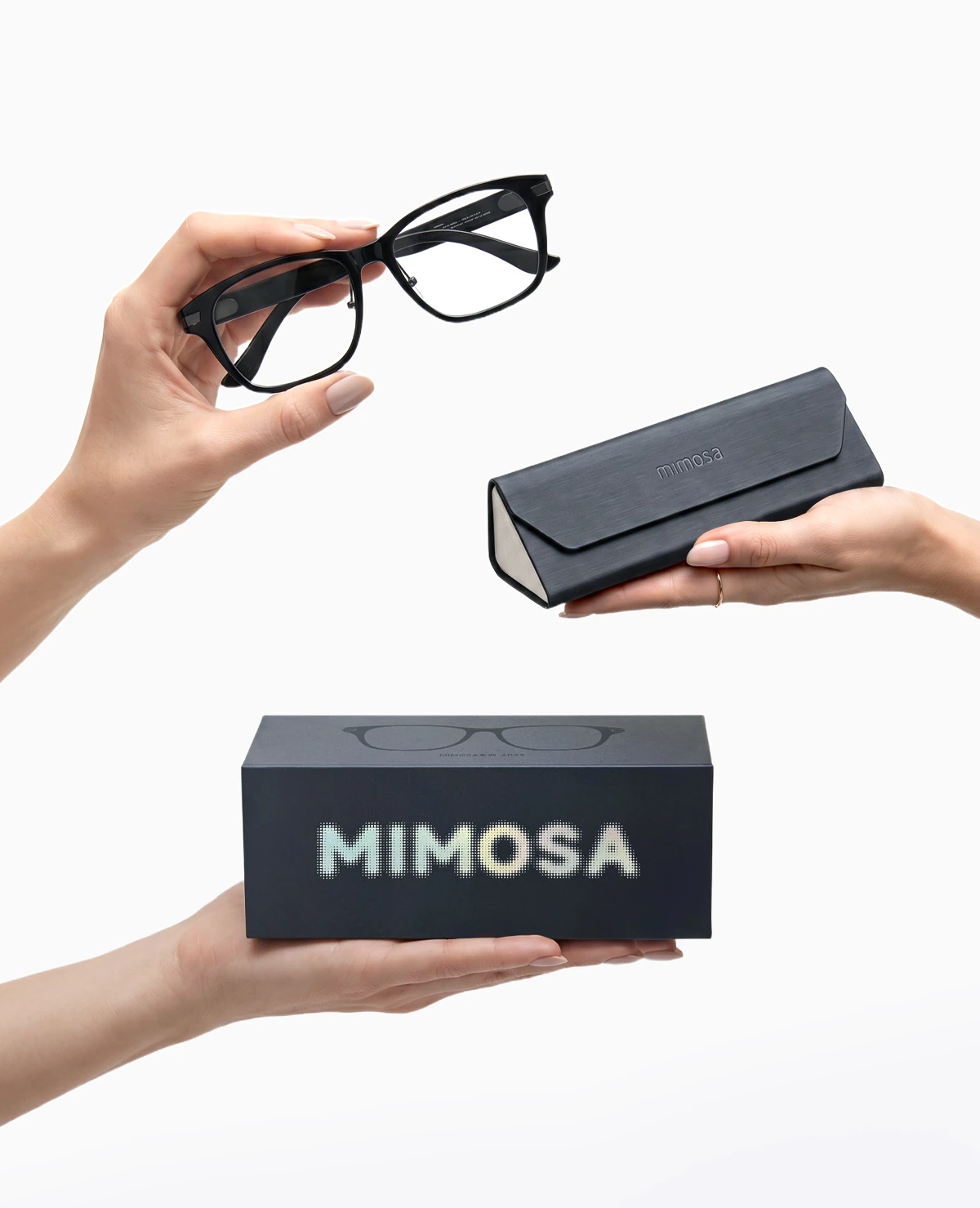
The reference sheet shows the glasses, folding case, charging/data cable, instructions, lens cloth, warranty card and conformity document. Final contents, logo, packaging language and compliance paperwork are confirmed per contract and destination market.

| Specification | Reference configuration |
|---|---|
| Product type | Camera-free monocular AR display glasses |
| Display | Right-eye monocular, single green channel |
| Resolution / refresh | 640 × 480 @ 30 Hz |
| Field of view | 30° |
| In-eye brightness | Up to 2,000 nits under reference conditions |
| Light engine | 0.12cc Micro-LED module |
| Waveguide | Volume holographic grating (VHG) |
| Bare-device weight | Approximately 28g, excluding prescription lenses |
| Battery | 100mAh fixed battery |
| Feature-use runtime | Approximately 1–3 hours under reference conditions |
| Standby | 72+ hours under reference conditions |
| Materials | Magnesium-lithium alloy and TR90; titanium-alloy hinge |
| Interaction | Physical key and temple touch area; smart ring integration is complete; interaction mappings depend on firmware and app; ring configuration and package contents are confirmed in the project quotation |
| Connectivity | Bluetooth, phone-tethered |
| Camera | None |
| Prescription lenses | Integrated and snap-in insert paths; fit and lens configuration confirmed per optical project |
| Software | Mentra OS support; paired phone with companion or partner application; software integration, localization and service scope are confirmed per project |
| Commercial model | OEM / ODM / JDM / white label; logo-branded pilots from 200 units |
| Production status | Mass production |
Reference configuration. Final specification is confirmed per project and target market. Actual runtime and standby vary with feature use, brightness, Bluetooth and app activity, network, environment and battery condition. Prescription power, lens thickness, alignment, fitting and final configured weight require optical-project confirmation.
AR99 contains no camera or image sensor. Information is displayed through the glasses; AI, translation and navigation run on the paired smartphone, partner application or connected service. This is a phone-tethered display architecture.
For daily-wear and enterprise projects, evaluate both the hardware and the software data flow: microphone source, permissions, storage, consent and connected-service behavior depend on the selected integration. Venue and workplace policies still apply to camera-free eyewear.
If your project requires visual capture, compare the K900 camera-equipped AI glasses platform and C100 standalone Android live AI platform.
Choose a starting scope for hardware, software, branding and market validation. Each project has an agreed specification and delivery boundary.
Use existing frames with your branding, custom retail packaging and app boot branding. Confirm the reference configuration, lens path, required software support and destination markets before quotation.
Evaluate frame geometry and CMF, lens configuration, firmware behavior, interaction mapping, localization, accessories, SDK and companion-app integration. The agreed scope determines engineering work and validation.
Define new industrial design, tooling, hardware configuration and software integration against a project specification. Engineering feasibility, certification scope, development stages and acceptance criteria are agreed for the project.
The reference optical engine, waveguide architecture, camera-free architecture, core compute platform, display resolution and colour channel define the baseline. Changes to these are assessed as new development rather than assumed to be standard options.
Commercial scope. AR99 supports OEM, ODM, JDM and white-label branding. Pricing, NRE and tiered volume terms are quoted on specification freeze. Certification scope and included deliverables are confirmed for the selected configuration and target markets.
Review SmartXY OEM and ODM manufacturing projects and Micro-LED waveguide AR display technology.
For partners evaluating a camera-free display product, a prescription-lens project or an app-assisted information workflow.
The work plan follows the agreed project scope; an existing-frame pilot and a new industrial design require different engineering and validation deliverables.
Review the sample and specification sheet against your target users and applications.
Agree frame, lenses, CMF, software, branding and market scope.
Where development is required: EVT prototype assembly, software V1 and SDK demonstration.
DVT functional, reliability, RF and market-specific certification testing within the agreed scope.
PVT manufacturability, fixtures, SOP and packaging preparation, followed by mass production.
AR99 and AR99-MY are both in mass production and support OEM / ODM customization. They share the optical and electronic platform, with frame-specific fitting, validation and commercial scope for each product project.
The camera-free unisex product uses a single-green right-eye display, a VHG waveguide and a 100mAh battery. Explore the AR99 AR display platform.
The independent women-first product shares AR99 optics, electronics, firmware and software, with its own frame geometry, nose pads and hinge system. Explore women-first cat-eye AR eyewear.
AR99 Pro: extended-operation configuration. AR99 Pro uses a single-green SRG waveguide with 25° FOV, 1,800-nit brightness, 25 g weight and carbon-fiber construction. Its two 40 mAh user-swappable batteries maintain operation during replacement, with a required paired ring supplied with every unit. EVT3 functional CNC prototypes support evaluation and industrial-design customization for mass-production projects. Review AR99 Pro operating requirements.
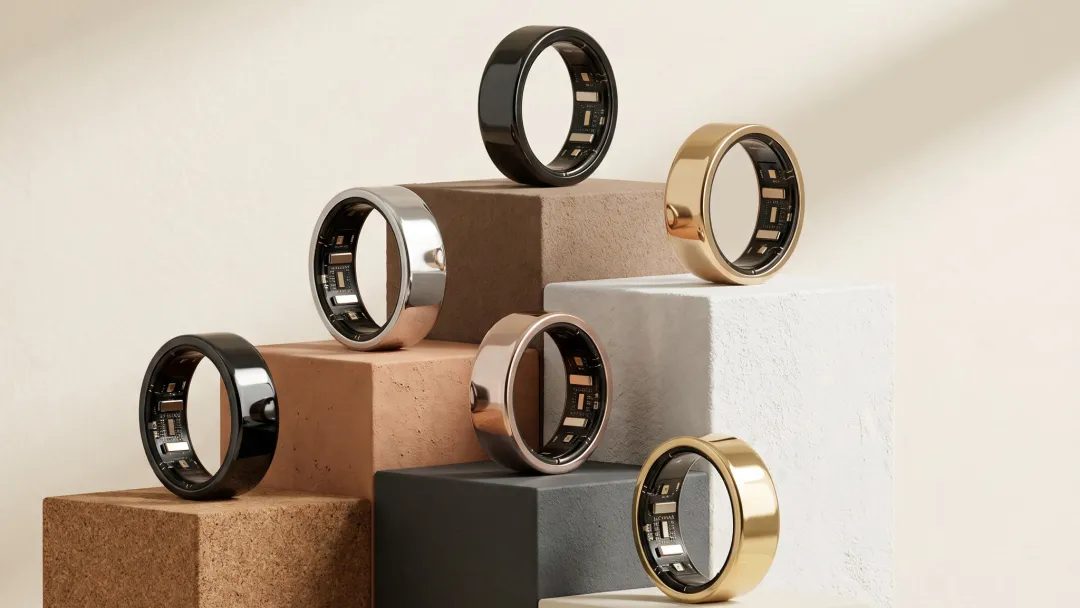
Smart ring integration is complete for AR99, AR99 MY and AR99 Pro.
Use a compatible smart ring alongside the physical key and temple touch area. Commands and control mappings follow the selected firmware and application.
For AR99 OEM / ODM projects, ring selection, finish and package inclusion are agreed in the project quotation.
AR99 supports Mentra OS for brand owners, distributors and wholesalers with local retail or channel coverage who want a supported software route without building a companion app from zero.
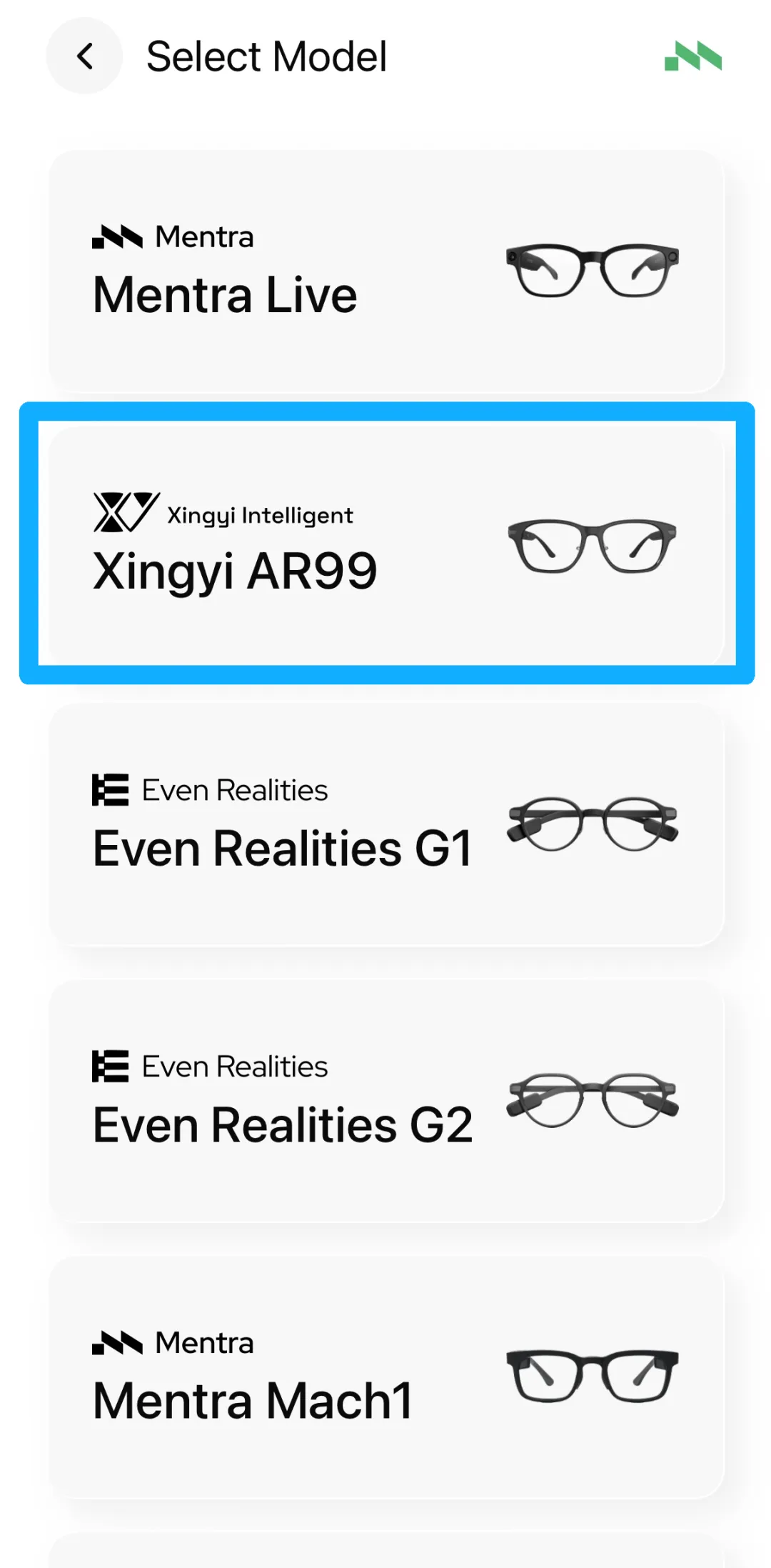
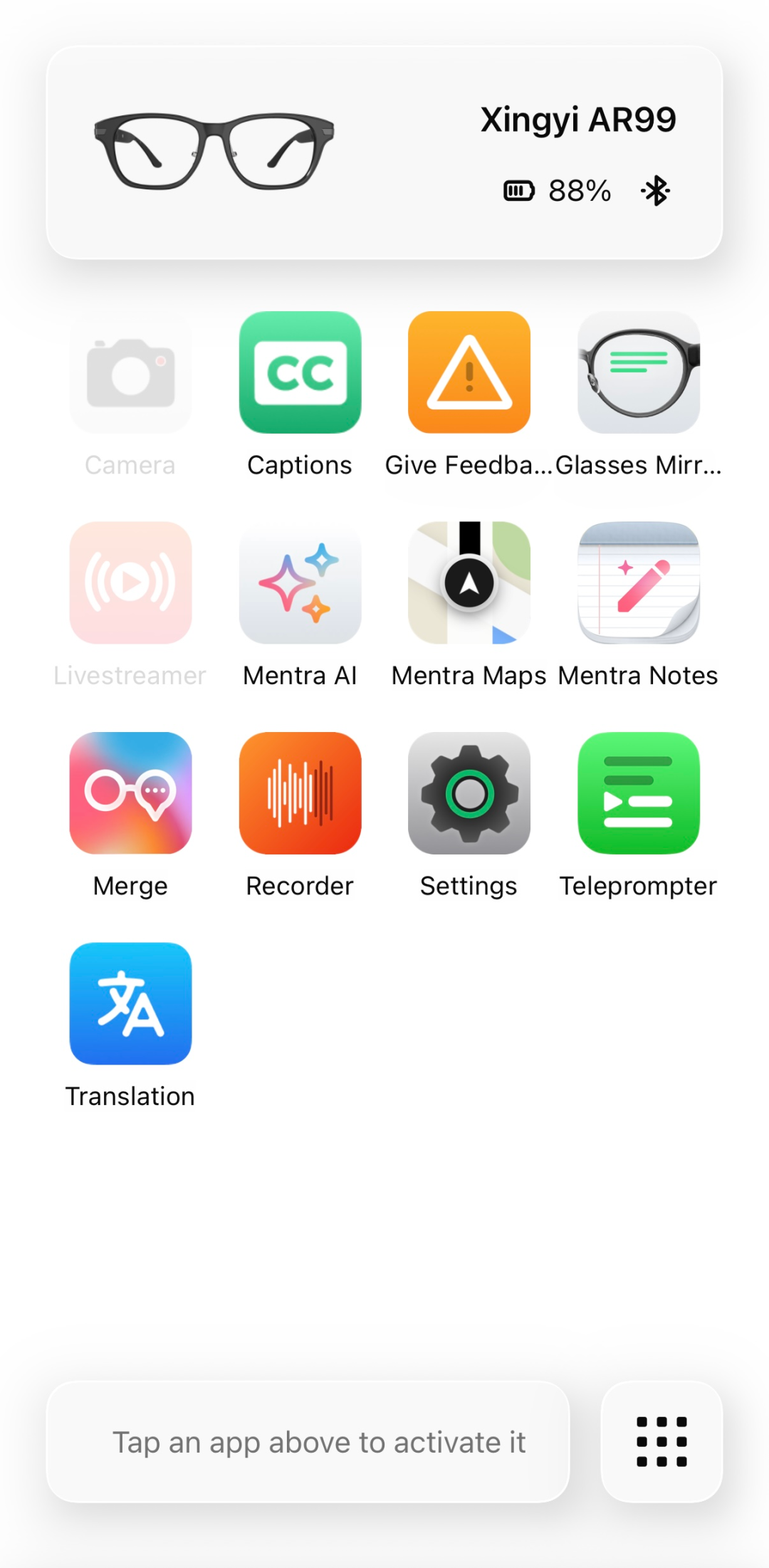
AR99 and AR99 MY support Mentra OS. The supplied screenshots show Xingyi AR99 in the model selector and connected app screen.
The supplied AR99 app menu shows Captions, Mentra AI, Mentra Maps, Mentra Notes, Recorder, Teleprompter and Translation. Review app version, language, permissions and target-market service availability for your project.
Camera and Livestreamer appear greyed out in this AR99 screen. AR99 and AR99 MY remain camera-free, phone-tethered display glasses.
Request AR99 Mentra OS setup and project details.
For a product-design perspective on display, fit and software boundaries, read Vanda’s personal camera-free AR glasses guide.
Related design record: review the applicant, identifiers, dates and documented status.
AR99 is a camera-free monocular AR display platform developed by SmartXY. It uses a Micro-LED light engine with volume holographic grating (VHG) waveguide optics to place short text and prompts in the right eye, in an approximately 28g bare-device frame.
No. AR99 is camera-free by design and contains no image sensor.
AR99 renders a single green channel. The right-eye monocular display provides 640 × 480 resolution at 30 Hz across a 30° field of view; it does not display full-colour images.
AR99 uses a volume holographic grating (VHG) waveguide and a 0.12cc Micro-LED engine. In-eye brightness is up to 2,000 nits under reference conditions.
Approximately 28g as a bare device, excluding prescription lenses. Final configured weight depends on the selected lenses and project.
The reference battery is 100mAh, with approximately 1–3 hours feature use and 72+ hours standby under reference conditions. Actual results vary with feature use, brightness, Bluetooth and app activity, network, environment and battery condition.
Yes. AR99 connects over Bluetooth to a paired phone. AI, translation and navigation run on the paired smartphone, partner application or connected service and are displayed through the glasses. Available functions depend on the integration and market.
Integrated and snap-in prescription paths are available. Lens power, thickness, optical alignment, fitting and warranty are confirmed through an approved optical partner for the selected configuration.
Yes. AR99 supports OEM, ODM, JDM and white-label projects. Logo-branded pilots run on existing frames from 200 units with custom retail packaging and app boot branding. Deeper customization is evaluated at RFQ; pricing and NRE are quoted on specification freeze.
Yes. AR99 is in mass production. The reference configuration, branding, software, lens project, delivery schedule and target-market scope are confirmed for each partner order.
Yes. Mimosa AR99-MY is an independent women-first cat-eye product at approximately 29g bare device. It shares the AR99 optical and electronic platform, firmware and software while using its own frame geometry, nose pads and hinge system.
AR99 Pro is a single-green SRG configuration with 25° FOV, 1,800-nit brightness, 25 g weight and carbon-fiber construction. Two 40 mAh user-swappable batteries maintain operation during replacement, and every unit includes the required paired ring. It is at EVT3, with functional CNC prototypes and industrial-design customization for mass-production projects.
No. Translation, AI prompts, teleprompter, navigation, transcription and notifications depend on the paired phone, approved partner application, connected service, network, market and project scope.
Share your company, target market, expected annual volume, preferred product and project type, lens requirements, software path and customization needs. SmartXY will review the project against the reference platform and the requested delivery scope.