Problem
Support awareness of viewing distance and posture during children's near-work activities.
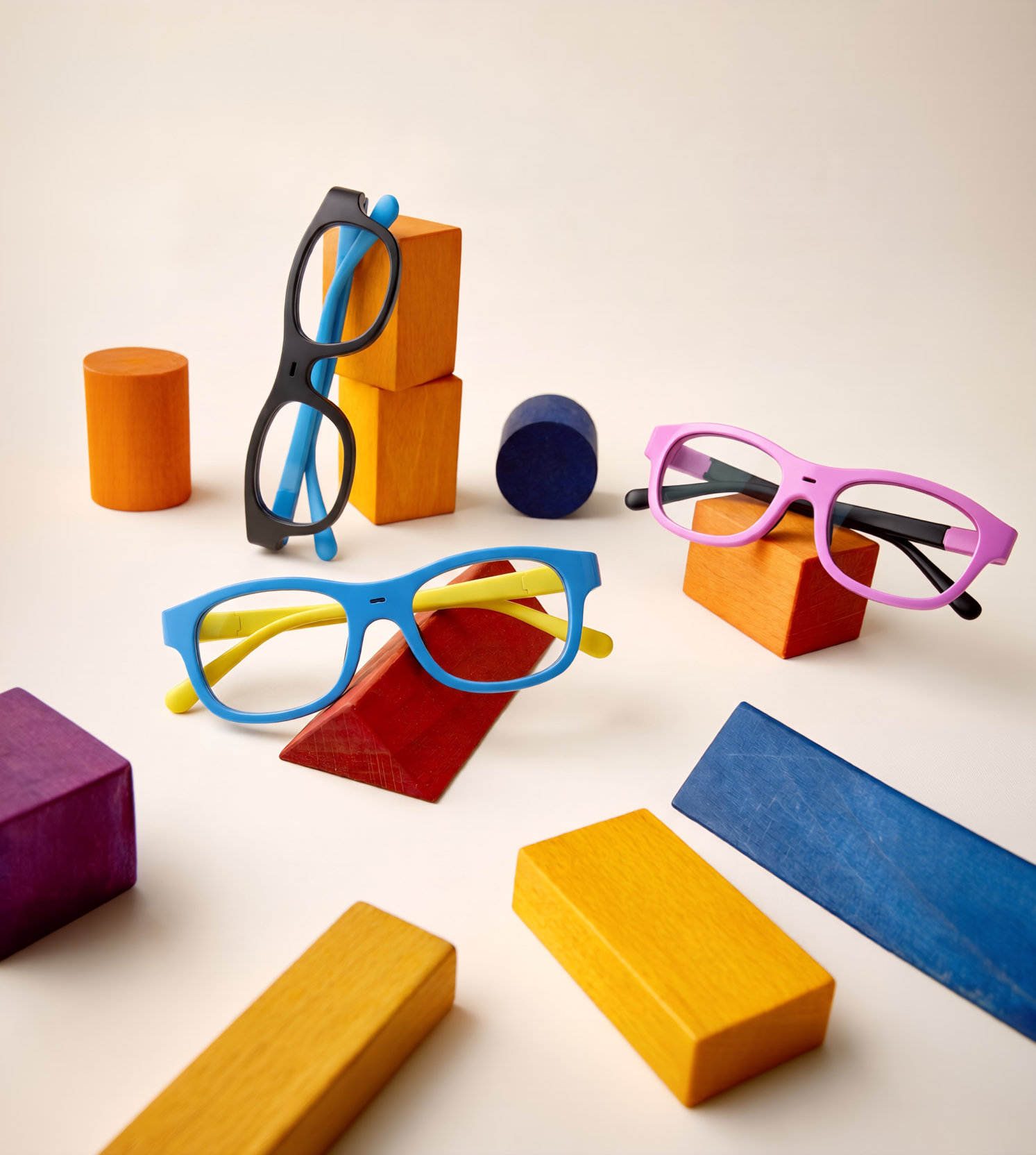
Nudge by SmartXY looks like ordinary children’s glasses. Inside, distance sensing, four-way tilt sensing, blue-light comfort lenses and smart fog feedback work together to gently guide children back to a healthier reading posture — without nagging, alarms or force.
PRODUCT FIT & DEVELOPMENT SCOPE
Support awareness of viewing distance and posture during children's near-work activities.
Nudge is a camera-free habit-support eyewear concept using distance and tilt sensing with a peripheral smart-fog visual cue. Its reference weight is approximately 30 g.
Children's-eyewear and habit-support product partners reviewing the intended age group, fit and use conditions.
Viewing-distance and posture-awareness support during reading and study. This is not a claim to treat, cure or prevent myopia, replace professional eye care or guarantee a clinical outcome.
Review fit, lens configuration, cue behavior, operating instructions and project-specific app or SDK requirements. Agree the selected configuration and validation criteria without assuming clinical evidence or a common production stage.
Most children’s eye-care products solve one fragment: light, posture hardware, reminders or optical correction. Nudge targets the early daily habit itself — where viewing distance and head posture are formed.

Filters part of the light, but does not manage distance, posture or behavior.

Constrains the torso but often misses head-down reading and side-tilt habits.

Measurement and reminders can be ignored when the feedback is too abstract.

Professional care is important, but it usually starts after the habit window is missed.

Distance + tilt + blue-light comfort + smart fog feedback form a physical closed loop.
Children respond better to immediate visual feedback than repeated verbal reminders. The lens cue happens at the exact moment the habit slips.
Fog appears when posture or distance slips; the view clears when the child self-corrects. That instant reward is the habit engine.
The product can be positioned as a good-habit support layer, avoiding risky medical promises while still solving a real parent pain point.
The product narrative should not promise instant transformation. A stronger, more credible message is a guided four-week adaptation curve: try, notice, accept, stabilize.

Try-on period. The child becomes aware of distance and posture cues.
Awareness
Regular wearing starts. Parents begin to see visible changes in reading behavior.
Visible shift
The glasses feel familiar. The cue becomes a companion, not a punishment.
Acceptance
Children naturally adjust distance and posture to keep the view clear.
StabilizationThe key strategic difference is not the sensor alone. It is the physical feedback loop that changes the child’s behavior at the moment of use.
Infrared distance sensing and four-way tilt sensing monitor near-work behavior.
The lens gently fogs when the child is too close or tilts too far.
The child naturally eases back, lifts the head or levels the posture.
The lens clears immediately, rewarding the corrected behavior.
Repeated cycles make proper viewing distance feel normal.

Nudge focuses on the real-world problem: children do not only sit too close. They lower the head, lean sideways, hunch forward and stay there. The system monitors those moments and uses the lens itself as the reminder surface.
Infrared ranging monitors near-work distance so the system can provide a cue when the child moves too close.
The lens gently fogs as a private visual cue and clears after the child corrects viewing distance or posture.
Blue-light-filtering lens support is designed for comfortable daily screen and study use; final lens specifications are confirmed per project.
Built-in sensing monitors viewing habits and sitting-posture changes in real time to support timely self-correction.
Four-way tilt sensing helps discourage prolonged forward tilt, side leaning and slouched posture without claiming a medical outcome.

This is the simplest way to explain Nudge to a parent or channel partner: when the child moves back into the comfort band, the view clears immediately.
The current engineering board has been integrated into the page with English content around it, so partners can quickly understand the hardware layout and user operation.
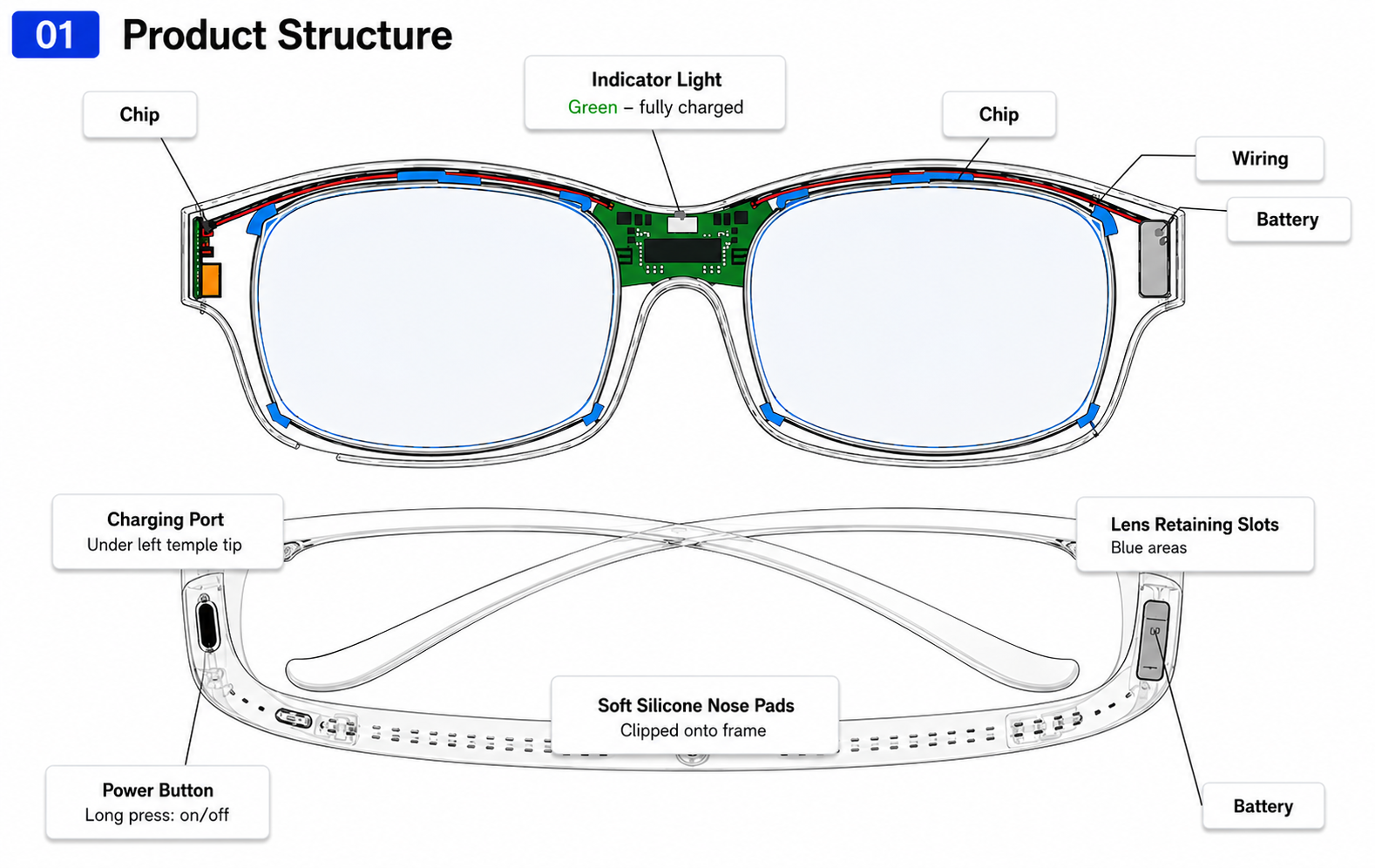
Original engineering reference artwork. The surrounding text describes the public product guidance; labels in the artwork do not establish additional product specifications or package contents.
Press and hold the power button for about two seconds. The indicator light confirms the glasses are entering working mode.
Place the frame above the ears, keep the soft silicone nose pads centered, and adjust the viewing angle until the fit feels stable.
The chip, lens layer and wiring work together to provide a quiet visual cue, helping children notice distance and posture habits.
Partners can request product, app and SDK guidance through SmartXY. Follow the instructions agreed for the selected product and project.
Coordinates distance sensing, posture sensing and fog feedback logic.
The smart fog lens layer provides the silent, private visual cue that children cannot easily ignore.
Integrated into the frame arms to keep the eyewear light and familiar.
Route app and SDK requests through the SmartXY RFQ form for the selected project.
The highest-value use cases are not dramatic. They are everyday: reading, homework, writing, tablets and classrooms.
Maintains a more comfortable distance during books and close reading.
Catches head-down writing and long desk sessions before they become automatic.
Combines blue-light comfort and distance guidance during digital learning.
Silent, private cues that do not embarrass the child or interrupt others.
Nudge is strongest when sold through trusted professional and premium retail channels: optometry centers, children’s vision-training institutions, eyewear chains and regional distributors.
The product reinforces professional advice between appointments without making medical claims.
Track wearing adherence, reminder frequency, parent feedback and sell-through before scaling.
A defensible habit-support category above ordinary glasses and below clinical project cost.
Launch with a low-risk first order in selected centers, with staff training and parent-facing material.
Agree on wearing adherence, return rate, parent acceptance and channel sell-through metrics.
When the pilot passes, expand volume and discuss regional or account-based exclusivity.